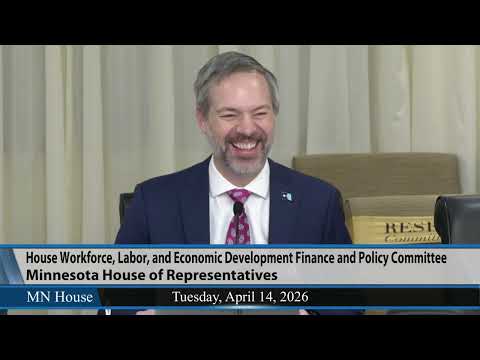
DEED commissioner outlines governor's supplemental workforce package, proposes social-media tax to fund AI preparedness
Loading...
Summary
A DEED commissioner presented the governor's supplemental recommendations to the House committee, including a proposed tax on large social media platforms to fund workforce training for increased AI use, emergency relief for businesses affected by 'Operation MetroSurgent,' and several program codifications and transfers.
A DEED commissioner told the House Workforce Committee on April 14 that the governor's supplemental budget would target a small set of strategic investments to prepare Minnesota's economy and workforce for expanded artificial-intelligence use.
The commissioner said the proposal would create a special-revenue fund—paid for by a proposed tax on large social media platforms—to finance workforce and economic-development initiatives aimed at AI preparedness. "The governor's recommending a tax on large social media platforms," the commissioner said, and staff estimated the revenue at about $46,000,000 initially and roughly $194,000,000 over the 2028–29 biennium.
Why it matters: committee chairs said they want a fiscally responsible plan that balances long-term financial health with targeted investment. The proposal pairs workforce training with new programs and a council to advise how funds should be spent.
Key elements: the commissioner described several components of the package. A $10 million emergency-relief fund would offer partially forgivable, zero-interest loans to small businesses hit by "Operation MetroSurgent," with forgiveness eligibility tied to revenue declines (the presentation cited a 33% decline threshold and a three-year loan term). The administration also proposed $3.5 million for the "Service to Success" initiative—grant funding to expand public-service opportunities tied to career pathways—and budget-neutral codification of long-running programs such as Pathways to Prosperity and the newer Drive for 5 sector strategy. The memo would also align an innovative business-development public infrastructure (BDPI) provision with existing Greater Minnesota policy and consolidate an appropriation to the Met Council for project management efficiency.
Committee debate focused on incidence and scale of the proposed social-media tax. Representative Schultz pressed the commissioner on whether Minnesota small businesses would ultimately bear the tax through higher advertising costs; the commissioner replied the tax is aimed at larger platforms and that whether companies pass costs to advertisers would depend on market responses. "Whether the companies then choose to try to pass that on to users, that's up to them," the commissioner said.
Members also raised questions about how much money the state needs to invest to achieve AI-readiness and whether the proposed revenue would be sufficient. Some members framed the issue as one of power and regulation—asking who sets guardrails for AI and how benefits and burdens would be distributed—while chairs urged bipartisan engagement to shape details before Thursday's planned consideration.
Next steps: the committee heard the presentation informationally (the bill is in the possession of the rules committee) andlaid over the administration's supplemental proposal for possible inclusion in a bill the chairs plan to present for a vote later in the week.