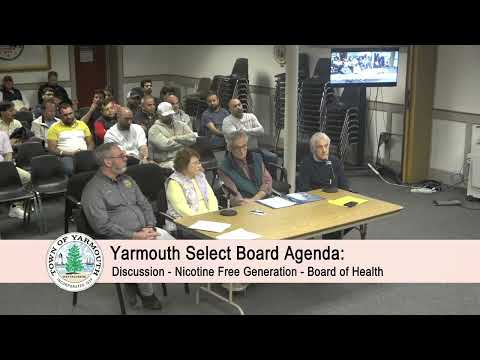
Yarmouth Board of Health outlines ‘nicotine‑free generation’ approach as Select Board hears business concerns
Loading...
Summary
Yarmouth’s Board of Health described a proposal to bar local nicotine sales to people born in or after a chosen year, saying the gradual, birth‑year cutoff would protect future generations. Residents and Select Board members warned of economic harm to small retailers and asked whether implementation should be delayed.
The Board of Health described at an April 14 Select Board meeting a proposal that would prohibit nicotine sales to anyone born in or after a fixed cutoff year, an approach proponents call a “nicotine‑free generation.” Hillard Boskey, a member of the Yarmouth Board of Health, told the board the idea is “essentially fixed — it’s based upon a fixed year of birth.”
The board said the concept began in academic literature and has been considered in other jurisdictions; presenters noted Brookline’s experience and subsequent legal challenges and said state lawmakers have introduced related bills. Eric Craig, vice chair of the Board of Health, summarized the arc, saying earlier efforts reached the state legislature and that “Brookline was the first and it was contested in court and the Supreme Judicial Court did say that it was legal.”
Supporters framed the policy as long‑term, gradual and protective of children. Boskey described the measure as “looking out for our children, our grandchildren,” and stressed that the policy would not cut off current adults from purchases — people born before the chosen year could continue to buy nicotine products for life, while those born on or after the year could not.
But residents and several Select Board members urged caution, citing short‑term economic impacts. A resident who identified themselves as a longtime local business customer told the board the town’s businesses are already strained by sewer construction and declining tourism and asked, “Do we have to be at the beginning of the pack?” Another resident warned that limiting sales could simply shift purchases to neighboring towns and drain local retail receipts.
Select Board members pressed the Board of Health on implementation options. Several asked whether the town could choose a later cutoff year or delay enactment until sewer work and other economic disruptions ease. Board of Health members repeatedly emphasized the progressive nature of the approach — it is designed to be phased in over decades — and said the town can select the starting birth year.
No formal action or vote was taken; the Select Board treated the session as a discussion and asked the Board of Health to continue its work and public outreach. The board and public repeatedly noted that the state legislature remains active on nicotine policy and that municipal actions can influence state debate.
What happens next: the Board of Health will continue public meetings and technical work; the Select Board did not place any binding town‑wide restriction that night. Any local policy would require a formal Board of Health vote and possible legal or legislative steps before enforceable changes occur.