Get Full Government Meeting Transcripts, Videos, & Alerts Forever!
Get email alerts on the Behavioral Health Clinical Trials topic
No spam. Unsubscribe anytime.
Senate clears HOPE Treatment Act to let Tennessee institutions join multi‑state ibogaine trials
Summary
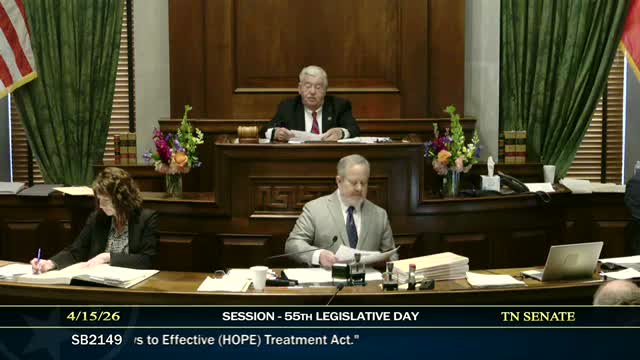
The Senate passed Senate Bill 21-49, the HOPE Treatment Act, creating a Council on Emerging Behavioral Health Treatments and an innovation fund; supporters said the measure enables participation in FDA‑approved ibogaine clinical trials for PTSD and opioid-use disorder and does not require state funding.
The Tennessee Senate passed Senate Bill 21-49, the Helping Open Pathways to Effective Treatment (HOPE) Act, which would authorize the state to participate in multi-state clinical-trial consortia for emerging behavioral-health treatments, including ibogaine, and create a council and a special innovation fund to manage participation and reporting.
Chairman Watson explained a rewrite (Senate Finance amendment) that rolled together language from committee amendments and removed the Department of Mental Health and Substance Abuse Services from certain sections while clarifying the state's financial interest. As amended, the bill establishes a Council on Emerging Behavioral Health Treatments to oversee participation, allows qualified institutions to apply to join a multi-state ibogaine clinical-trial consortium (with an application window beginning no later than Sept. 1, 2026), requires participating institutions to submit quarterly progress reports and verify expenditures of matching funds, and creates an Emerging Behavioral Health Treatment Innovation Fund. The sponsor explained the bill requires the state treasurer to deposit no less than 50% of state revenue from any FDA-approved medication developed into the fund.
Sponsor Senator Wally said the bill "establishes that council on emerging behavioral health treatments that focus on advancing research and access to Ibogaine for those suffering from PTSD and opioid use disorder." He said the measure will allow Tennessee to participate in FDA-approved clinical trials in a consortium of multiple states and that it would not require state funding. "This multi state public private partnership is gonna allow Tennessee to participate in this consortium," he said, and supporters highlighted testimony to committees from veterans and providers about the treatment's potential.
Chairman Watson noted the amendment rewrote and streamlined previous committee language, and the finance committee moved the amendment on the floor. The bill passed: Aye 29, Nay 1.
Next steps: As written and explained on the floor, the council may authorize qualified institutions to be members of multi-state clinical trials; institutions would be subject to quarterly reporting and verification of matching funds. The special account created would receive certain state revenue streams specified in the bill, including a share of state revenue from any FDA-approved medication developed and monetized in the future.