Get Full Government Meeting Transcripts, Videos, & Alerts Forever!
Get email alerts on the Social Services topic
No spam. Unsubscribe anytime.
Mesa Fire’s social‑services outreach credited with cutting repeat 911 use in case examples
Summary
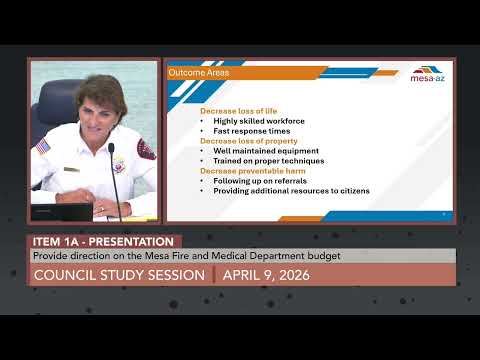
Mesa Fire Medical staff said a social‑services referral program targeting frequent 911 users reduced calls for many clients (mean ~45% reduction in analysis; case example fell from 11 to 3 calls). Council asked for follow‑up data on conversion rates and per‑call costs.
A department social‑services lead told the council the Mesa Fire and Medical Department has an on‑agency social‑service team (two social workers and an intern) that manages referrals from crews for people who repeatedly call 911. Staff said they define a frequent utilizer as someone who calls 911 more than three times in 90 days and that they run a pre/post 90‑day analysis to measure effect.
The presenter said the program’s average reduction across cases is about 45 percent after intervention, with cited examples ranging from a 31 percent improvement (after removing a 24‑call outlier month) up to 74 percent in some aggregated metrics. One case study presented described a 60‑year‑old woman whose baseline was 11 responses; after environmental fixes (food box, grab bars provided by a volunteer program), referrals to senior‑living assessment (SAIL) and coordination with hospital and APS social workers, her responses dropped to three — a 73 percent reduction.
Council members pressed staff on how a person is identified as a high utilizer and how referrals are triggered. Staff detailed a workflow: crews check a “social services” box in the patient‑care reporting system while on scene, which generates a referral to the social‑services team. The team then case‑manages contacts, arranges environmental or care transitions as appropriate, and tracks outcomes. Staff said they receive around 100 referrals per month (not all become frequent utilizers) and offered to supply councilors with further data on how many referrals convert to repeated users and the estimated taxpayer cost per deployed response.
Councilors and city management discussed upstream mitigation efforts, including community risk reduction, public‑education outreach, and regional options such as a 311 nonemergency line; staff cautioned that 311 is a regional build and that triage at the dispatch level is constrained by the need to answer emergent calls quickly.
The council did not vote on policy changes; staff were asked to return with additional data on referral outcomes and cost analyses.