Mesa council reviews Fire & Medical budget, life‑cycle projects and new equipment grants
Loading...
Summary
Mesa officials reviewed the Fire and Medical Department budget and capital plan, including major life‑cycle replacements (SCBA packs, dispatch consoles), station buildouts, expansion of medical response vehicles and a $725,000 AFG grant to buy 35 automated CPR devices with a 10% city match.
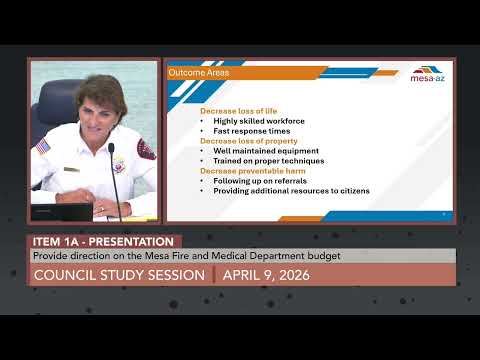
Vice Mayor Summers opened the study session to hear the Mesa Fire and Medical Department’s budget presentation and asked staff to move through the agenda quickly to respect a 9:00 a.m. time limit.
A finance presenter summarized the department’s financials and life‑cycle projects, saying the proposed 2026–27 budget includes equipment replacements and one‑time capital carryovers: roughly $1,000,000 in station carryover, $4,000,000 for self‑contained breathing apparatus packs (replaced on a 15‑year cadence), $1,000,000 for CPAP ventilators, $1,400,000 for dispatch consoles and a $500,000 line for whole‑body MRI screenings for the department’s cancer‑prevention program. The presenter said overtime in dispatch drove a one‑year spike in incident response costs for 2025–26 and that moving four positions into the public‑safety sales‑tax fund allowed an $800,000 reduction in next year’s overtime projection.
Fire leadership told council the department plans to expand medical response vehicles (MRs) in denser areas to meet medical call demand while preserving all‑hazards engine availability; two MRs are currently in service and staff said additional MRs will be added as buildout and station siting progress. Chief Lachlan described response‑time reporting (50th/70th/90th percentiles) and linked improvements to newly opened stations (21 and 22) and the planned Station 24, while noting a planned GPS‑triggered intersection preemption RFP intended to reduce intersection delays by an estimated 15–30 seconds at problematic locations.
On equipment procurement, staff said the department will purchase 35 LUCAS automated CPR devices funded primarily by an Assistance to Firefighters Grant (AFG) for $725,000 with a 10 percent city match (~$75,000) to be paid from ambulance/transportation operations; the devices will be carried on frontline ambulances, with units reserved for training and spares.
Councilors asked for additional detail on per‑call costs and overtime math; staff offered to provide the detailed cost breakdown and historical rosters to help evaluate the tradeoff between hiring versus paid overtime. The presentation closed with an update on station construction timelines: a station on 80th Street and Elliott is more than 50 percent complete and expected to be ready in November, while another site is proceeding through demolition and groundwork with an estimated opening in about a year.
The council did not take a final vote on the budget at this study session; staff said adjusted position assignments and the proposed cut to overtime will be reflected in forthcoming budget documents.