Lifetime Citizen Portal Access — AI Briefings, Alerts & Unlimited Follows
Minn. Senate Labor Committee hears testimony on worker-owned cooperatives, conversion hurdles and public support
Loading...
Summary
Practitioners and worker-owners told the Senate Labor Committee that worker-owned cooperatives help retain local ownership, build worker wealth and stabilize communities, but cited the need for funding for feasibility studies, technical assistance and succession planning.
The Minnesota Senate Labor Committee held an informational hearing on worker-owned cooperatives, where cooperative advocates and worker-owners described conversions from traditional firms to employee-owned models and urged targeted state support to scale the approach.
Ben Nelson, executive director of Cooperative Network, told the committee Minnesota cooperatives generate “over $11,000,000,000 in economic output, support almost 80,000 jobs and deliver several $100,000,000 in net state and local tax revenue,” and urged lawmakers to see worker co-ops as part of that broader ecosystem. Nelson framed worker co-ops as “businesses owned and governed by employees operating on one worker, one vote,” and said they help with succession planning and keeping local ownership in communities.
Katie Marty of Co-op Minnesota, a program of a cooperative development nonprofit, defined co-ops as member-owned, democratically governed organizations in which surplus is returned to members. Marty highlighted Minnesota’s established cooperative sector — from Land O’Lakes and CHS to rural electric co-ops and credit unions — and said worker ownership can address housing and child-care shortages by enabling community-rooted solutions.
Worker-owners and practitioners gave concrete examples. Dave Abbott, a carpenter at Terra Firma Building and Remodeling, described his company’s conversion in 2013 and said his firm grew from about a dozen employees to 35 with 22 owners; Abbott said the founder financed the sale to workers with a long loan that made ownership affordable. Abbott urged education, patient timelines and public support to help owners and workers complete conversions instead of having businesses sold to outside buyers.
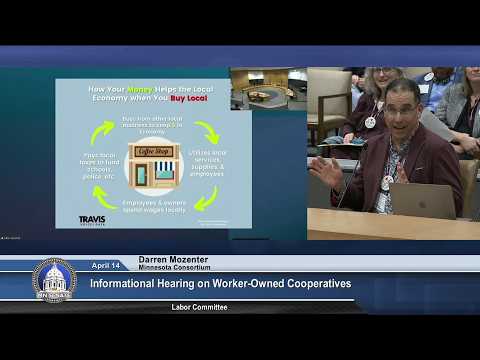
Darren Mazenter, senior shared ownership advisor at the Minnesota Consortium of Community Developers, and several worker-owners from Positively Third Street Bakery described wealth-building outcomes: smaller internal pay ratios, profit distributions tied to hours worked, higher employee retention and examples of home purchases and debt repayment tied to cooperative earnings.
Leslie Watson, executive director of Cooperative Development Services, outlined a typical five-stage conversion pathway — exploration, assessment, structure, execution and ongoing support — and said public grants can make early-stage assessments feasible. Watson noted CDS used a USDA Rural Cooperative Development Grant to build capacity and pointed to Minnesota Department of Agriculture cooperative development grants (typically $5,000–$50,000) as a model for early financing that could be extended to worker co-ops.
Committee members pressed for details on conversion costs and timelines; Watson estimated some conversions can be completed in six months but others may take up to two years depending on valuation and financing complexity. Chair McKeown and several senators expressed interest in a follow-up hearing to examine differences among worker co-op models and potential state incentives or technical assistance.
Next steps: The chair said staff and members will follow up and schedule deeper review in another hearing.