Longview board hears budget planning, Bowen projects 6,238 FTE and flags state cuts to kindergarten and categorical funds
Loading...
Summary
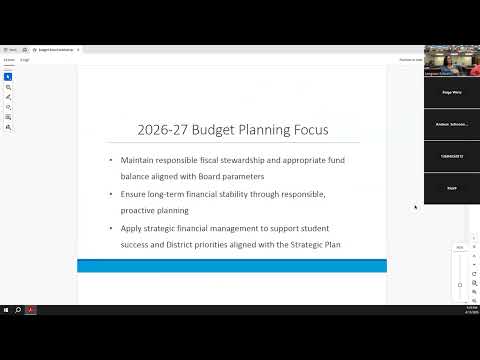
At an April 13 work session, Executive Director Patty Bowen told the Longview School District board she projects 6,238 student FTE for 2026–27 and outlined state legislative changes that reduce transition-to-kindergarten slots and certain categorical grants; district staff will finalize staffing by April 30.
At a April 13 work session, Executive Director of Business Services Patty Bowen told the Longview School District board she is projecting “a total of 6,238 student FTE, which is 20 less than what we budgeted,” and outlined how recent state legislative actions are reshaping the district’s 2026–27 budget outlook.
Bowen said enrollment remains the district’s largest revenue driver and described the district’s projection methodology — cohort survival rates, program-level adjustments, and Portland State kindergarten trend data — that produced the 6,238 annual average FTE figure. “Enrollment is showing we are flat, and we are very, very close to where we budgeted for this year,” she said, while noting even small shifts can change staffing needs because roughly 83% of the district budget is personnel costs.
The presentation moved from enrollment to the state legislative outcomes Bowen said will affect Longview. She reported a new exemption, effective July 1, for certain enhanced sales taxes applied to specified services; the district estimates that exemption will produce roughly $415,000 in savings starting in the new fiscal year. Bowen cautioned that the savings apply to the newly expanded service taxes only, not to routine purchases such as equipment.
Bowen said a more consequential local effect comes from changes to transition-to-kindergarten (TTK) funding. She said the legislature removed TTK from the basic-prototypical funding model and placed it in capped categorical funding with tightened eligibility. As a result, Bowen reported Longview’s TTK cap will fall “from 127 to 101 student FTE,” a reduction she described as “just over 20%” and roughly equivalent to the loss of two classrooms locally.
She also described changes to levy equalization (local effort assistance). Bowen said a planned per-pupil equalization increase used in last year’s forecast was reduced by the legislature (from an assumed $250 per pupil to about $150), and she estimated that change will reduce the district’s projected revenue by about $450,000 in later years if current formulas hold.
Bowen flagged categorical-grant uncertainty and building-level eligibility changes tied to free-and-reduced reporting. She said Robert Gray and Mark Morris schools — which briefly qualified for high-poverty LAP funding under a community-eligibility snapshot — will fall below the 50% rolling threshold used for LAP next year and that the district expects about $432,000 in reduced categorical funds for those buildings.
On benefits and salary assumptions, Bowen said the state’s implicit price deflator (IPD) used in the prototypical model is 2.6% and noted SEBB (School Employees Benefits Board) health-rate increases of about 5.13% (from $1,307 to $1,374 monthly). She said retirement-rate assumptions remained unchanged this year but stressed the combined effect of salary and benefit costs matters because staffing drives roughly 83% of district spending.
Board members pressed Bowen on capacity issues, the influence of running-start and alternative-learning enrollments on FTE counts, and how cohort-survival assumptions alter high-school projections. Bowen said the district monitors building capacity continuously and applies program-level adjustments to avoid double-counting students who participate in running-start or alternative programs.
Bowen said the district is finalizing staffing decisions for next year and aims to complete those decisions by April 30; she noted the state recommends staff notices by May 15 so secondary scheduling can proceed. She said the district intends to reallocate positions as retirements and resignations occur rather than issue widespread layoffs where possible.
What’s next: Bowen said staff will incorporate the legislative changes and negotiated agreements into the district’s four-year forecast as details and bargaining agreements are finalized. She also said staff will update the board at future meetings and hold grade-band and advisory-committee briefings through the budget-development timeline.
Votes at a glance: At the start of the meeting the board approved routine agenda items, a consent agenda and a motion to remove the Arlon student representative from the agenda; later the board approved Nutrition Policy 6700 on second reading (voice votes; the president announced each motion passed).