Get Full Government Meeting Transcripts, Videos, & Alerts Forever!
Get email alerts on the Rpp And Street Cleaning topic
No spam. Unsubscribe anytime.
Residents and council press APA on residential permits and street‑cleaning enforcement after study raised equity questions
Summary
Council and residents pressed APA leadership on how residential parking permits are established, why tickets are sometimes issued after street sweepers pass, and data cited by a Lehigh Valley Justice Institute study that suggested disparate ticketing; APA said it enforces city ordinances and will provide disaggregated data for review.
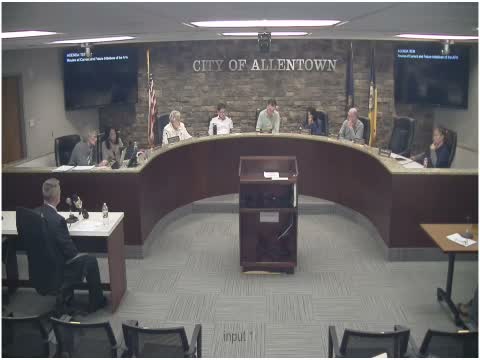
Council members and residents used a public meeting with the Allentown Parking Authority (APA) on April 16, 2026 to press for clearer rules and better communication around the residential parking permit (RPP) program, street‑cleaning enforcement and equity questions raised by a recent study.
John Haney, APA executive director, reminded the council that RPP is created by city ordinance and administered by the APA only after resident petition. "This is not an APA program," he said. "We simply administer it." He described the statutory criteria the APA uses to evaluate petitions (proof of vehicle ownership and residency) and noted the ordinance currently sets no cap on permits per household; the APA charges $25 for a first‑year permit and $20 for renewals.
Several council members and residents said some Center City blocks have mixed commercial frontage that complicates RPP eligibility and urged the council to consider ordinance revisions so outcome criteria are clearer and more consistent. Haney agreed the code needs updating in places and supported ordinance review initiated by council.
The Lehigh Valley Justice Institute study, raised by council members, showed higher ticketing rates in certain neighborhoods and suggested possible targeting. Haney did not dispute the raw numbers but said comparisons to smaller neighboring cities were incomplete because Allentown maintains 24/7 enforcement and follows city‑set street‑cleaning runs and meter placements. "To claim that that's some kind of an intentional targeting of a neighborhood based on an income level or an ethnicity, I don't know how you can do that when we're just simply following the street cleaning run," he said, and the council asked for disaggregated geographic data to better evaluate the findings.
On street‑cleaning enforcement timing, residents described cases where drivers said they returned after sweepers and still received citations. Haney said the ordinance prohibits parking during posted sweep hours "until the street is cleaned," and the APA follows sweepers to document impediments so the citation will be upheld by magisterial district justices. He acknowledged operational tradeoffs — including vehicle damage when patrol vehicles drive ahead of sweepers — and offered to investigate reported incidents.
Council asked for clearer public communications about re‑parking after sweepers pass, more accessible maps or Code Red alerts showing sweep status, and the APA agreed to explore technology options and coordination with public works. No ordinance change was adopted that night; council requested follow‑up reports and recommended committee review.
Public commenters urged more outreach and education rather than punitive enforcement alone. AJ Nee, a former APA enforcement officer, told the council that enforcement plays a safety role and that improved communication and ordinance updates could reduce friction between residents and the APA.
Next steps: Haney said the APA will provide the meter study, geographic breakdowns of calls and tows, and additional data on appeals and enforcement timing for council review.