Lifetime Citizen Portal Access — AI Briefings, Alerts & Unlimited Follows
APA director details towing, payment plans and return of 24/7 enforcement at Allentown council meeting
Loading...
Summary
At a special Allentown City Council meeting, APA Executive Director John Haney reviewed the agency's 2025–2026 operations — including towing counts, a new payment‑plan program, reinstated 24/7 safety patrols and a debt load that constrains revenue sharing with the city — and answered council questions about residential permits and street‑cleaning enforcement.
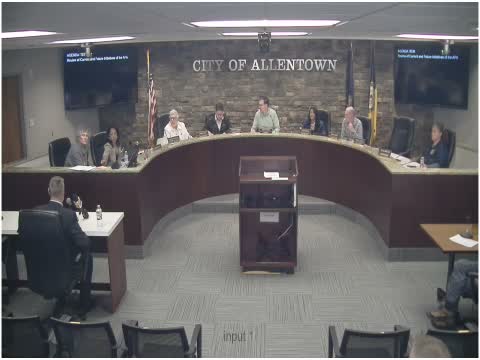
John Haney, executive director of the Allentown Parking Authority, outlined the agency's annual report and answered detailed questions from City Council and residents at a special meeting on April 16, 2026.
Haney said the authority removed 132 abandoned vehicles last year, worked with the County Auto Theft Task Force to recover eight stolen cars and handled 17,866 calls to its dispatch line in the prior year. He reported towing totals of 156 vehicles so far in 2026, with specific causes including 43 for 72‑hour violations, 70 for fire‑hydrant parking and 12 for unpaid tickets. For the full year 2025, Haney said the APA towed 957 vehicles, with the largest single category being unpaid tickets (380) and a substantial miscellaneous category (174) for hazards or stripped vehicles.
"We track all of the vehicles that we tow and the various reasons that we tow them," Haney said, and added the authority can provide more detailed reports on request.
Haney described a payment‑plan option the APA launched to reduce court referrals: an eligible ticket holder must request a plan within the first 10 days after issuance, and plans allow six installments. From August 2025 to March 2026 the authority opened 286 plans; Haney said roughly 70 percent were paid in full, about 23 percent did not complete the plan and the remainder were still pending or sent to court.
On overnight enforcement, Haney said APA reinstated proactive 24/7 patrols in 2024 after a suspension in 2023. He emphasized the overnight program is narrowly focused on safety violations — fire hydrants, no‑parking zones, double parking and corner clearances — and does not include meter enforcement.
"When 24/7 was reinstituted, it was relegated to only those types of violations, safety violations," Haney said, noting the change followed consolidation of dispatching at the county level that shifted parking calls to APA.
Council members pressed Haney on booting and towing practice: the APA uses a contracted towing vendor and places boots to hold vehicles until tow arrival so the authority is not billed if a vehicle moves before the tow truck arrives. Haney said boot fees reflect equipment and staff time and that the authority can exercise discretion to waive fees in limited scenarios.
Haney also reviewed operational recommendations from an APA meter study, including adding pickup/drop‑off zones in downtown corridors and piloting license‑plate‑reading technology for managing curb uses. He highlighted staffing and training: the APA employs 94 people and runs regular community‑relations training for enforcement staff; the agency offers a language bonus to employees who pass proficiency tests, Haney said.
On finance, Haney described a large debt service burden for parking structures that limits the authority's ability to transfer surplus revenue to the city. "In 2025, the authority was carrying a $56,000,000 debt load. In 2026, we're carrying a $57,000,000 debt load," he said, and added that the authority provides some in‑kind services and occasional small contributions to city events.
Council and residents asked for follow‑up data — including geographic breakdowns of calls and tows, revenue impact of the 24/7 return and the full meter‑study file — and Haney pledged to provide the requested reports. Former APA enforcement officer AJ Nee, in public comment, said his experience reinforced safety reasons for proactive enforcement and urged improved communications to residents.
The council ended the meeting by asking staff to bring ordinance updates and further reporting for committee review; no formal vote on policy changes took place at the session.