Lifetime Citizen Portal Access — AI Briefings, Alerts & Unlimited Follows
PSD board hears detailed budget briefing as district plans for enrollment-driven cuts
Loading...
Summary
Budget director Brian Gustafson and CFO Dave Montoya told the Poudre School District board that state School Finance Act changes, declining enrollment and hold-harmless funding leave the district planning for fewer funded pupils and larger structural challenges; the board was advised to expect a preliminary budget April 28 and to prepare for about 250 positions affected by local reductions.
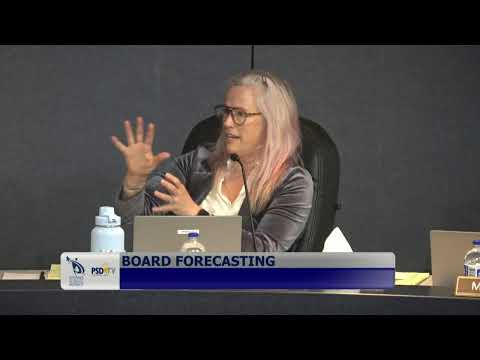
Budget director Brian Gustafson and CFO Dave Montoya presented a technical update to the Poudre School District Board of Education on April 14, laying out how changes to Colorado’s School Finance Act, declining enrollment and hold-harmless calculations will affect district revenue and budgeting.
Gustafson said implementation of the 2024 school finance law is being phased in at 15% per year and noted that the district is planning for roughly 654 fewer full-time-equivalent (FTE) students for next year; using the phased averaging rules he described, that translates into an expected funded-pupil-count decline of about 762 pupils in next year’s calculations. "We're building a budget based on 654 fewer FTE," Gustafson said, adding that the district will finalize a preliminary budget for the board by April 28.
CFO Dave Montoya framed how overlapping finance formulas and hold-harmless provisions create a gap the state currently fills for the district. He said the district’s total program funding this year was established at about $324.5 million, and that the new formula calculates a lower amount that is bridged by hold-harmless adjustments. "Part of that is being phased in while we phase out the old act," Montoya said, adding the result is uncertainty about recurring revenue beyond the phase-in period.
Board members pressed presenters on the risk of midyear rescissions and how charter enrollment changes could affect the district’s total program funding. Gustafson and Montoya said rescissions are possible (they have happened in other districts during economic downturns) but are not the baseline assumption; the district is modeling scenarios that include the state’s use of one-time funds and potential future policy changes.
Superintendent Brian Kingsley praised the finance team’s work and reiterated the timeline for upcoming budget milestones: preliminary budget April 28, proposed budget May 26 and adoption before June 30, pending the state’s final legislative actions. "We will continue to regularly share updates," Kingsley said, urging community members to follow board engagement sessions and posted resources.
Board members discussed reserves and the need to avoid building recurring expenditures on one-time state dollars. Several directors asked for public-facing tools to make the district’s assumptions and numbers more accessible; Director Scott Schoenbauer and others referenced a forthcoming dashboard being discussed by the comprehensive planning committee.
The presentation included specific planning assumptions the district said it has used in modeling: 654 fewer FTE, a three-year pupil-count averaging method next year (moving toward two years thereafter), the phase-in of the new formula, and potential charter enrollment shifts that could reduce the district’s total program amount. Montoya said the district is preparing plans to use hold-harmless or one-time revenue to restore reserves rather than commit to recurring costs.
The board’s discussion concluded with a request that staff and committee work produce clearer public materials and legislative-impact scenarios to inform the May and June budget decisions.
Next steps: the district will publish the preliminary budget April 28 and continue outreach and Q&A sessions as state actions solidify.