Get Full Government Meeting Transcripts, Videos, & Alerts Forever!
Get email alerts on the Paris Va Match topic
No spam. Unsubscribe anytime.
Washington State official explains how PARIS VA match helps verify veterans’ benefits
Summary
A PARIS training by ACF explained how the PARIS VA match (an SSN-based extract from the Defense Manpower Data Center and VA systems) helps states identify veterans benefits, reduce improper payments, and connect veterans to unpaid entitlements — and where the extract has limits, such as SSN-only matching, whole-dollar amounts, and missing apportionee SSNs.
Tim Don, a veterans benefits coordinator with the Washington State Health Care Authority, told a virtual PARIS training that the PARIS VA match is a practical tool for state eligibility staff to verify whether clients receive VA benefits and to reduce improper payments. "It is matched by SSN social security number, through the defense manpower data center," Don said, describing how the Defense Manpower Data Center matches state recipient information to the VA benefits extract and returns a file states can use to check benefit receipt.
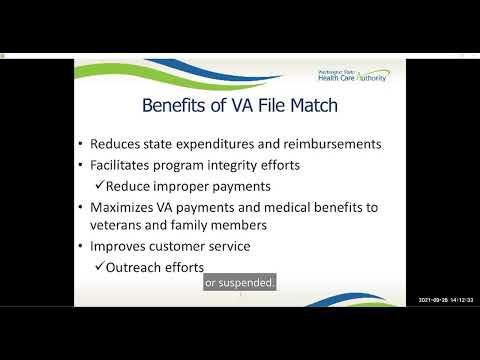
Don walked attendees through the extract’s most useful fields — VA file number, veteran and beneficiary SSNs, payee type, award type and award-line codes — and urged staff to consult the PARIS website for the extract layout. He said the file supplies information on payment type and amounts, and can indicate terminated or suspended payments, which helps eligibility staff discern whether a claim is current or closed. "This facilitates program integrity efforts by reducing these improper payments and maximizes VA payments and medical benefits to veterans and family members," he said.
The training highlighted two practical cautions. First, because the match is done on SSN only, it can produce some erroneous matches when SSNs are incorrect in either VA or state systems. Don advised users to filter questionable matches and, when necessary, confirm directly with the VA because PARIS runs quarterly and match data can be several weeks old. "You may still want to make that phone call and just to confirm they're currently receiving that because the match may be a couple months old," he said during the Q&A.
Second, Don noted extract presentation quirks: some payment amounts in the VA extract appear in whole dollars (a legacy of how VETSNET exported rates) even though compensation is actually paid to the cent. He also pointed out that apportionment records (payments split to spouses/children) often lack the apportionee SSN in the extract, which limits automated matching. Don said providing partial apportionee SSNs would make verification far easier for states.
The session reviewed substantive definitions and numeric examples that matter for eligibility work: compensation is tied to disability rating (a "combined degree") and not means-tested, while pension is need-based and depends on a maximum annual pension rate (MAPR). Don gave sample figures used in training materials (MAPR for a single veteran at $13,920 annually or $1,160 monthly) and explained how aid and attendance stacks with pension benefits. He also described DIC (Dependency and Indemnity Compensation) subtypes for surviving spouses and children and special monthly compensation variants that can substantially increase payments.
On practical verification and contacts, Don said states can use the PARIS file to identify likely benefit recipients but sometimes should confirm by phone through the VA’s published line; he also suggested accredited state Department of Veterans Affairs service officers can be a local resource. During closing, ACF moderators provided a resource contact: "paris@acf.hhs.gov" and said the presentation would be posted on the PARIS site within 24–48 hours.
The training included a question-and-answer session in which Don clarified that VA pension rates update annually in January to follow the Social Security Administration’s cost-of-living adjustment, that VETSNET is the VA payment extract while Burroughs (as described in the session) is a larger directory of service records, and that PARIS runs are quarterly — all factors eligibility staff should consider when using the data. The session closed with an announcement of a live state experience panel scheduled for Oct. 5 featuring presenters from Washington, Colorado and Tennessee.