Lifetime Citizen Portal Access — AI Briefings, Alerts & Unlimited Follows
District fiscal staff explain how LCFF and restricted grants fund Mountain View schools
Loading...
Summary
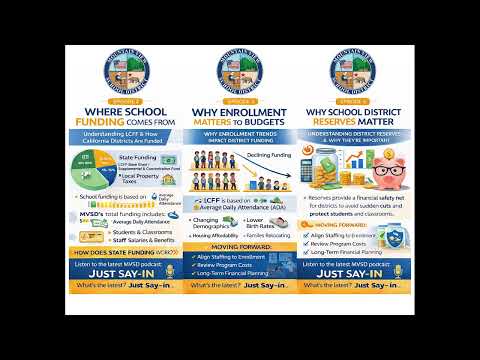
On the Just Sayin' podcast, Mountain View School District fiscal director Lisa Loop said California's Local Control Funding Formula (LCFF) is the district's primary revenue source, supplying more than 95% of unrestricted funds and about 70% of total funding; she described supplemental funding streams for high-need students and listed restricted grants that support programs and facilities.
Lisa Loop, the Mountain View School District's senior director of fiscal services, told the district's Just Sayin' podcast that California's Local Control Funding Formula, or LCFF, is the district's principal source of revenue.
"LCFF stands for Local Control Funding Formula, which is California's main system for funding public schools," Loop said. She explained the state largely allocates money based on student attendance, measured as average daily attendance or ADA, and that the formula provides a base grant for every student.
Loop said the LCFF also provides targeted funds for students who need additional support. "The state provides supplemental and concentration funding for students who are English learners, students from low income families, and foster youth," she said, adding that those dollars help districts deliver programs and services aimed at improving student success.
On the episode, Loop gave a summary of how LCFF fits into the district's overall budget. "Our LCFF funding provides more than 95% of our unrestricted funding and approximately 70% of all district funding, so it's critical," she said. She listed other restricted revenue streams that the district uses for specific programs: federal title programs, other state and federal grants, local grants, and categorical funding for before- and after-school programs, special education, professional development, reading, music and art, and facility modernization and construction.
Dr. Darren Dechenecker, associate superintendent of business and strategic planning, framed the episode by saying understanding the funding sources is "critical for our staff, our parents, and our community," and encouraged listeners to follow board meetings and fiscal services presentations for deeper detail. The episode ended with a standard sign-off and a reminder to visit the district website for more information.
The podcast discussion was descriptive: Loop outlined how money is allocated and what it is typically used for but did not announce any new budget decisions, votes, or policy changes during this episode.