Get Full Government Meeting Transcripts, Videos, & Alerts Forever!
Get email alerts on the Behavioral Health topic
No spam. Unsubscribe anytime.
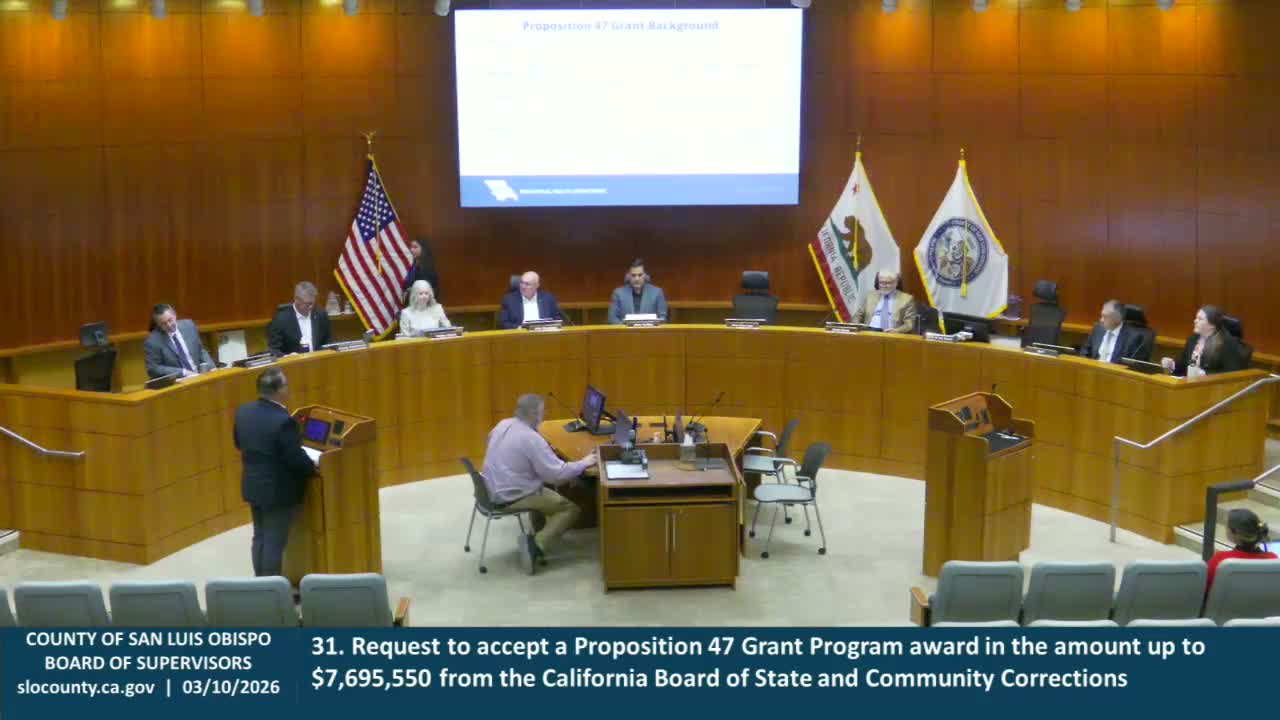
Board accepts nearly $7.7M Prop 47 grant to expand court‑linked treatment and community services
Summary
The board approved retroactive acceptance of a Prop 47 grant of up to about $7.6–7.7 million to fund a three‑year Preventing Reoffense (SLO Prop) program that will screen and treat justice‑involved people eligible under Prop 36 and emphasize community‑based services and case management.
The Board of Supervisors on March 10 approved acceptance of a Prop 47 grant award that will fund a three‑year county program aimed at diverting eligible justice‑involved individuals into treatment and reducing recidivism.
Frank Warren, interim director of Behavioral Health, described the Preventing Reoffense (SLO Prop) grant from the Board of State and Community Corrections: the award—about $7.6 to $7.7 million over a three‑year performance period—will finance screening and assessment, two treatment pathways (ASAM‑level outpatient services and higher‑level residential referrals as needed), medicated‑assisted treatment, drug testing, case management and an emphasis on community‑based partners. The grant requires that at least 51% of services be delivered by community‑based organizations; the county will partner with local providers including the 5 Cities Homeless Coalition and Transitions Mental Health Association.
Staff said the program expects to target at least 300 participants over three years (roughly 100 per year minimum, with courts controlling referrals) and to leverage Medi‑Cal billing where possible to increase sustainability. Warren said some staff currently funded by ending grants would be reassigned and that the grant adds seven FTEs over the three‑year period.
Board members asked about sustainability beyond the three‑year grant and whether accepting Prop 47 funds would affect advocacy on Prop 36’s unfunded treatment obligations. County attorneys and executive staff said the grant represents state budget reinvestment and that the county will continue to pursue permanent funding solutions while deploying awarded funds to address immediate program needs.
Community partners—including Transitions Mental Health Association and 5 Cities Homeless Coalition—testified in support, citing existing jail‑to‑community case management pilots and horticulture/occupational programs that the grant would expand. The board voted unanimously to accept the award and directed staff to pursue discussions on permanent funding for Prop 36 treatment obligations.
What’s next: staff to finalize grant acceptance paperwork, begin recruitment for funded positions, coordinate with courts for referral pathways, and return progress reports as required under the grant.