Get Full Government Meeting Transcripts, Videos, & Alerts Forever!
Get email alerts on the Budget topic
No spam. Unsubscribe anytime.
County projects modest baseline surplus but faces add-back requests and reserve choices in FY26‑27 budget update
Summary
County executive staff reported a $13.6 million baseline surplus for FY26‑27 but noted 66 add-back requests totaling $14.5 million and 65 budget augmentation requests totaling $10.3 million; staff recommended recognizing $25.9 million in Medi‑Cal reimbursements as one‑time reserve funding and returned to the board for May 19 budget introduction.
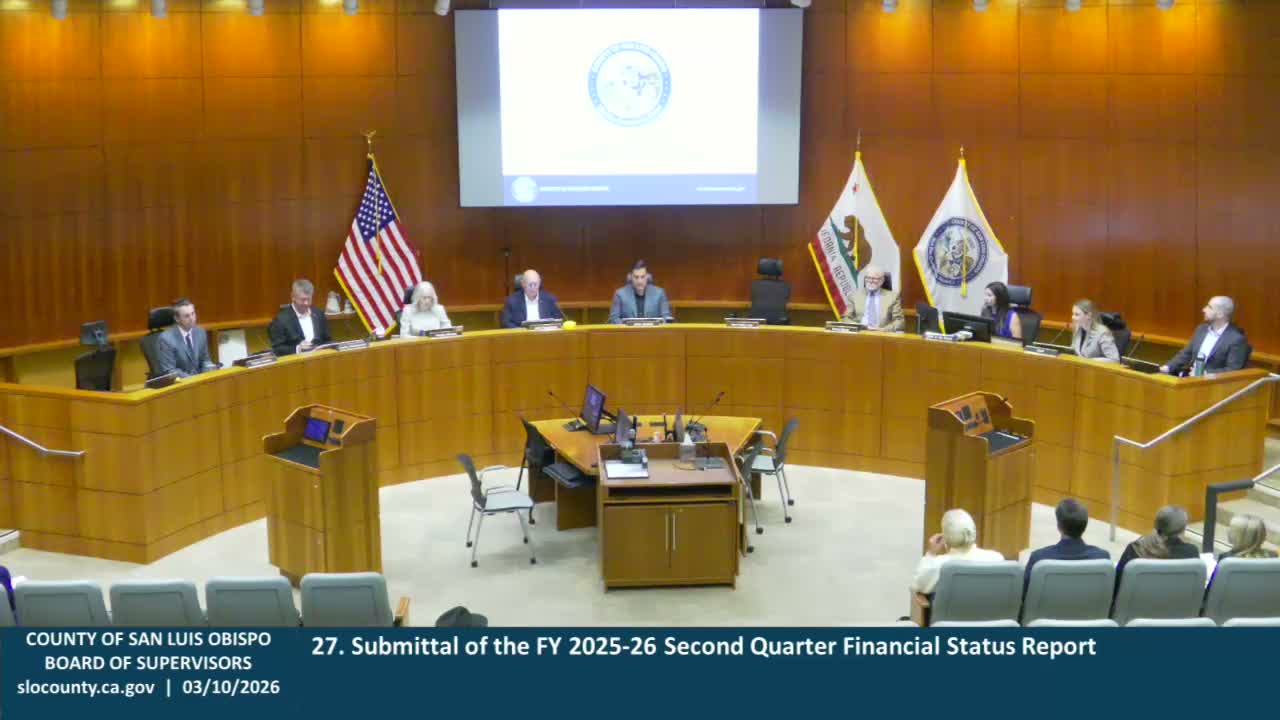
County Executive Office staff on March 10 told the Board of Supervisors that San Luis Obispo County’s preliminary budget work for fiscal year 2026‑27 shows a $13.6 million baseline surplus but faces a series of add‑back and augmentation requests that could erase that cushion.
In a staff presentation, Lisa Howe of the executive office said departments built budgets using office‑provided baseline numbers and were asked to internally rebalance. Staff identified 66 add‑back requests totaling $14.5 million in general fund support and 65 budget augmentation requests totaling $10.3 million and 44 new position requests. That combination, if fully funded, would convert the projected baseline surplus to a deficit in the near term.
Why it matters: the board adopted a baseline budgeting approach this year to limit structural commitments in a fiscally uncertain environment, and supervisors pressed staff to apply board priorities when deciding which add‑backs and new requests to recommend.
Key revenue and risk details cited by staff included a projected 3.6% overall growth in non‑departmental revenue driven mostly by property‑tax increases, persistent uncertainty in state and federal funding (including impacts from HR1), and several one‑time financing items such as higher interest revenue and KPMG‑identified Medi‑Cal reimbursements. Staff proposed recognizing roughly $25.9 million in Medi‑Cal reimbursement revenue as a one‑time financing source and transferring it into the county’s tax‑reduction reserve to strengthen contingency levels.
Board questions centered on timing and analysis. Supervisors asked when staff would present finalized trust‑account and reserve analyses; Howe said initial recommendations and presentation materials are expected at the May 19 budget introduction and that the budget hearings will follow in June. Several supervisors asked for more detail on how increased discretionary revenue would be allocated department‑by‑department and pressed for greater transparency on trust accounts and the auditor‑office reviews used to identify one‑time financing.
Public comment noted broader revenue pressures. A local parent and county resident urged the board to continue advocacy for restoration of the unitary tax tied to Diablo Canyon power‑plant valuation, noting past large impacts to school and county revenue.
What’s next: staff will continue weekly budget meetings with departments, return with more detailed trust‑account and add‑back prioritization materials for the May 19 recommended budget introduction, and brief the board during June budget hearings. The report was received and filed; staff will incorporate board direction into the recommended budget.
Sources: Presentation and responses at the March 10 San Luis Obispo County Board of Supervisors meeting, County Executive Office staff report and Q&A.