Get Full Government Meeting Transcripts, Videos, & Alerts Forever!
Get email alerts on the Zoning Truck Stops topic
No spam. Unsubscribe anytime.
Fergus Falls planning commission reviews draft 'truck stop' zoning aimed at guiding Kwik Trip-style developments
Summary
City staff presented a draft ordinance adding a 'truck stop' use to the B2 zoning district — defining it by location (within 2,500 feet of the interstate) and truck-oriented features — and commissioners discussed signage, lighting, stormwater and landscaping before directing staff to revise and circulate a condensed draft.
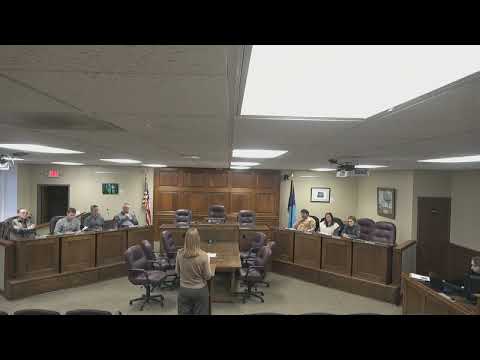
Clara Beck, community development director and planning commission staff liaison for Fergus Falls, presented a draft ordinance to add a “truck stop” use to the city’s B2 zoning district and explained the measure was prompted by interest from a national convenience-store operator. Beck read the proposed definition, saying a truck stop would be “a facility including any appurtenant parking or service areas … distinguished … by its design and purpose to provide services for commercial motor vehicles in addition to service for non commercial vehicles,” and that the draft ties the use to parcels within 2,500 feet of the interstate.
The proposal would add truck stops as a use by right in the B2 district (and allow the use in industrial zones), and include installation standards intended to protect nearby neighborhoods: limits on canopy signage and illumination, requirements for maneuverability and fueling access, architectural guidance, paved truck service areas, and landscaping intended as a buffer. Beck said some technical controls — fueling equipment standards and other operational licensing — remain regulated outside the zoning code and would be handled through building permits and state licensing.
Commissioners focused on how prescriptive the new language should be. Paul Vukanich, a commissioner with an engineering background, urged the group to consider standardized chain designs and practical signage allowances, saying the city should “look at what most of those are generally, and let's try to set it so those would all be allowable.” Another commissioner suggested raising canopy-signage coverage from 20% to 50% or placing canopy signage rules into the general signage code to avoid creating awkwardly specific sections for one business type.
Stormwater and impervious-surface controls drew attention. A commissioner recommended cross-referencing the city’s MS4 permit requirements rather than copying older numeric standards from Cannon Falls, noting state and federal stormwater standards apply and staff agreed to reference MS4 language instead of repeating potentially obsolete figures.
Lighting also surfaced as a key concern: the draft contains different illumination benchmarks depending on proximity to residential areas (for example, a 1-foot-candle limit near residences versus 15 foot-candles generally). Commissioners debated whether to require developers to submit comprehensive lighting plans and how to keep measures enforceable in practice. Beck proposed consolidating redundant lighting language while retaining stronger protections where developments abut residential districts.
Several commissioners warned the ordinance read, in places, like it was written for a single project. Beck acknowledged the draft was built from examples used by other Minnesota communities (notably Cannon Falls) but said the intent is to create a baseline that applies consistently across future projects while allowing staff and the commission to add context-specific flexibility.
Beck said she will incorporate the commission’s feedback — condense and clarify overlapping standards, reference the MS4 stormwater requirements, reconsider the 25% landscaping metric, and refine signage and lighting language — and circulate a revised draft for written comment before the item proceeds to city council. She reminded the commission that ordinances require two council readings and a notice period before taking effect. No formal vote on the ordinance was taken; the commission provided direction for staff edits and follow-up.
What happens next: staff will send an updated ordinance draft to the commission and then forward the item to the city council for the two-reading adoption process.