Get Full Government Meeting Transcripts, Videos, & Alerts Forever!
Get email alerts on the Higher Education Investment topic
No spam. Unsubscribe anytime.
Beaufort County Council approves $11.1 million seed funding for USCB convocation center; vote splits council
Summary
After hours of public comment and council debate, Beaufort County approved option 4—a one-time $11.1 million package drawn from existing county funds—to seed the University of South Carolina Beaufort convocation center, with council members split over priorities and future costs.
Beaufort County Council voted to adopt “option 4,” directing $11.1 million in existing county funds toward a University of South Carolina Beaufort (USCB) convocation center, after in-person testimony from university officials and extended discussion among council members.
County staff described option 4 as a combination of $9.5 million from the 2025 geo-bond series and about $1.6 million from prior appropriations that could be contributed without issuing new county debt or increasing the millage rate. “That’s what option 4 was,” staff told council as they summarized the funding sources.
Supporters said the investment is a strategic seed contribution that could unlock additional state and private funding while supplying a regional venue for athletics, concerts and emergency operations. Dr. Tim Pierce, a retired surgeon and chair of the Beaufort Jasper Higher Education Commission, urged the council to fund the project now to avoid rising construction costs and to support student and community programming. “Our ask is actually for $20,000,000 … the 20,000,000 means we can start right away,” Pierce said during public comment.
University officials framed the project as an economic and workforce strategy. Landon Jones, USCB vice chancellor for finance and operations, said option 4’s $11.1 million would allow the university to grow within its existing footprint and help retain younger families and professionals. “This option allows USCB to grow within its existing footprint, avoiding expansion into new areas while continuing to support local business,” Jones said.
Opponents warned that county priorities and unfinished infrastructure projects — such as roads, sidewalks and emergency facilities — could be crowded out by a large higher-education investment. One council member said the university had previously requested $47 million and questioned whether additional asks would follow. “If we take this off in chunks … $20,000,000 is a lot of money, and we have road projects, sidewalks, infrastructure needs that need to get done,” a council member said.
Council members also discussed whether the matter should go to voters. Vice chair Tabernick said she preferred placing a funding question on the ballot so residents could decide the county’s role. Others argued that a seed contribution would be key to attracting private and state leverage and that delay would inflate costs.
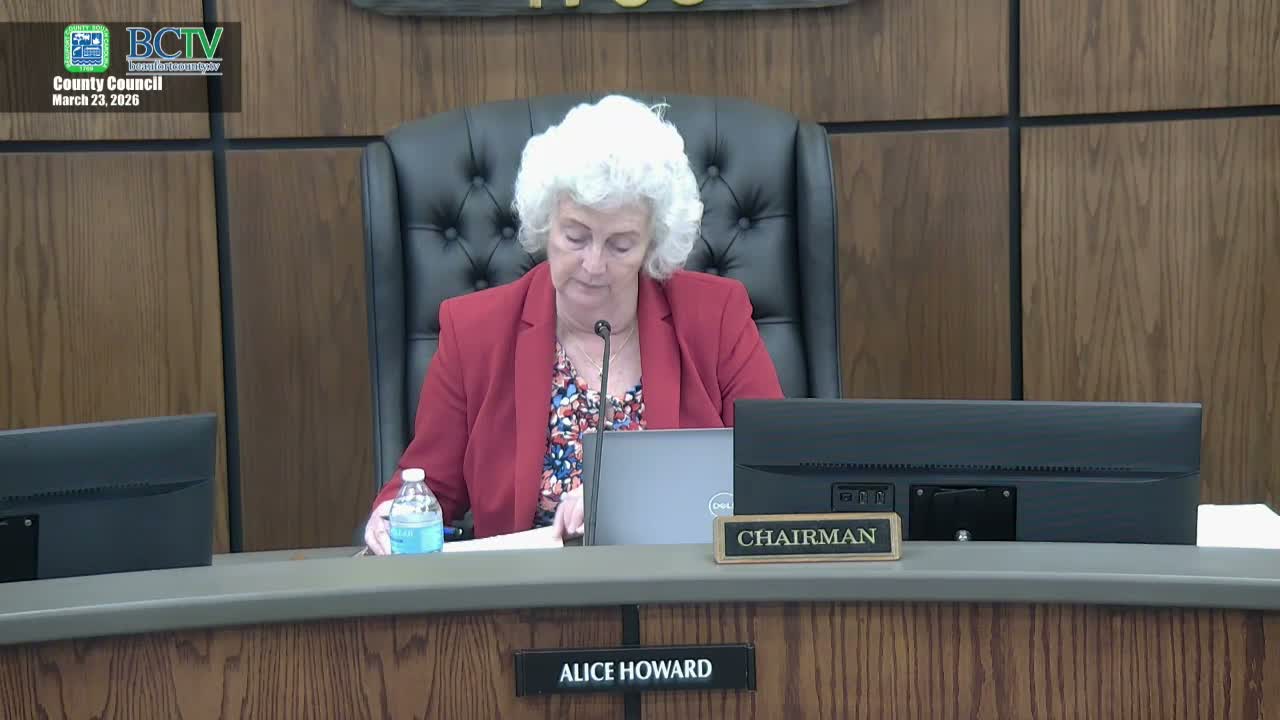
After public comment and debate, a motion to adopt option 4 passed on a roll-call vote. The clerk’s roll call recorded yes votes from Passman, McGowan, Lawson, Dawson and Bartholomew and no votes from Reitz, Cunningham, Brown, Tabernick and Chair Howard; an additional affirmative vote was recorded during the roll call, and the chair announced, “The motion passes.”
What happens next: staff told council that, if option 4 is accepted, the finance office will return with the necessary ordinance and budget actions to effect the transfer and appropriate the funds. University and county officials said they will continue fundraising and planning to limit future requests of county taxpayers.
The council moved on without scheduling another vote on the item at that meeting; staff indicated further ordinance language and bond-ordinance amendments would be required to complete the funding transfer.