Get Full Government Meeting Transcripts, Videos, & Alerts Forever!
Get email alerts on the Transportation Sidewalks topic
No spam. Unsubscribe anytime.
Isanti council advances $517,000 Railroad Avenue project and authorizes Main Street sidewalk work
Summary
The Isanti City Council voted 3-1 to call improvement hearings and authorize plans for a $517,000 Railroad Avenue reconstruction and a $73,000 Main Street sidewalk infill, with most costs borne by the city and some assessable to property owners; council debated engineering fees and assessment options.
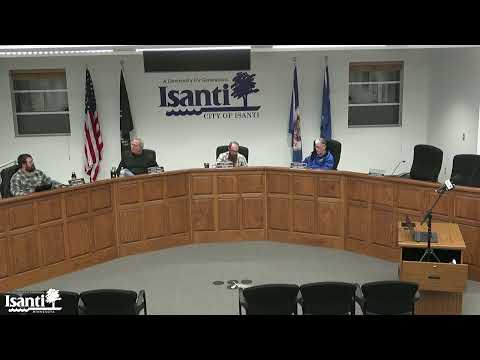
The Isanti City Council voted to move forward with design and improvement hearings for Railroad Avenue and a Main Street sidewalk infill after a presentation by the city’s engineering consultant.
At a council meeting, the consultant, Mister Cook, described the Railroad Avenue concept: shifting the curb line to create an ADA-compliant sidewalk, relocating catch basins and two hydrants, and performing targeted pavement reclamation rather than a full rebuild. He said the Railroad Avenue package is estimated at about $517,000, with the city’s share about $449,000 and assessable costs of roughly $68,000; the Main Street infill was estimated at $73,000 to be deferred as an assessment to the vacant parcels that would be developed later.
“Railroad Avenue project, is a total cost estimate of 517,000 and change,” Mister Cook said, adding the city’s share and the assessable portion in his summary. Council discussion focused on trade-offs between doing the sidewalk now under a state-aid process (which adds design and permitting costs but allows state aid participation) versus deferring work to a future developer and using a developer-built approach.
Several council members questioned engineering costs and the not-to-exceed engineering estimate of about $120,000. The consultant explained that the figure covers required state-aid deliverables — stormwater modeling, permitting, materials testing, surveying and inspection — and that the engineering fee was set not to exceed State Aid limits. “This is a not to exceed number,” Mister Cook said, noting state aid typically covers up to 25% of engineering on such projects.
Staff and the consultant described assessment policy options: under the city’s current policy, new sidewalks that were not petitioned by property owners are typically not assessed in residential areas, but the roadway portion could be assessed at 25%; the Main Street sidewalk infill on currently vacant commercial parcels was proposed as a deferred assessment when the parcels develop. The consultant noted a typical frontage cost of about $26.52 per foot in the preliminary assessment roll.
Council approved the motions to call two separate public improvement hearings (one for Railroad Avenue and one for the Main Street infill) and to proceed with preparing final plans and bidding, with the schedule aiming for public hearings in March and potential award in April. The motion passed 3-1, with the mayor recording the lone opposition.
Next steps include finalizing plans prior to the improvement hearings, an open house and localized owner outreach. Council members asked staff to pursue available survey data from a property owner and to try to minimize design costs where feasible; staff said there remains flexibility to remove the Main Street infill from the bid package if council prefers before award.
The improvement hearings and final assessments will determine the final scope and any charges to property owners; council members emphasized they can stop the project at several checkpoints before construction if bids or community feedback change the project calculus.