Get Full Government Meeting Transcripts, Videos, & Alerts Forever!
Get email alerts on the K12 Budget topic
No spam. Unsubscribe anytime.
Denton ISD reviews enrollment, attendance and state-funded allotments ahead of next year’s budget
Summary
District staff told trustees enrollment has risen while attendance (ADA) has lagged, prompting a 2026 budget ADA of 30,800 (94.5% rate). Staff highlighted pre-K growth, increases to early-education and special-education allotments under recent legislation, Fast Growth Allotment tier risks, and uncertainty around vouchers and Denton Digital enrollment.
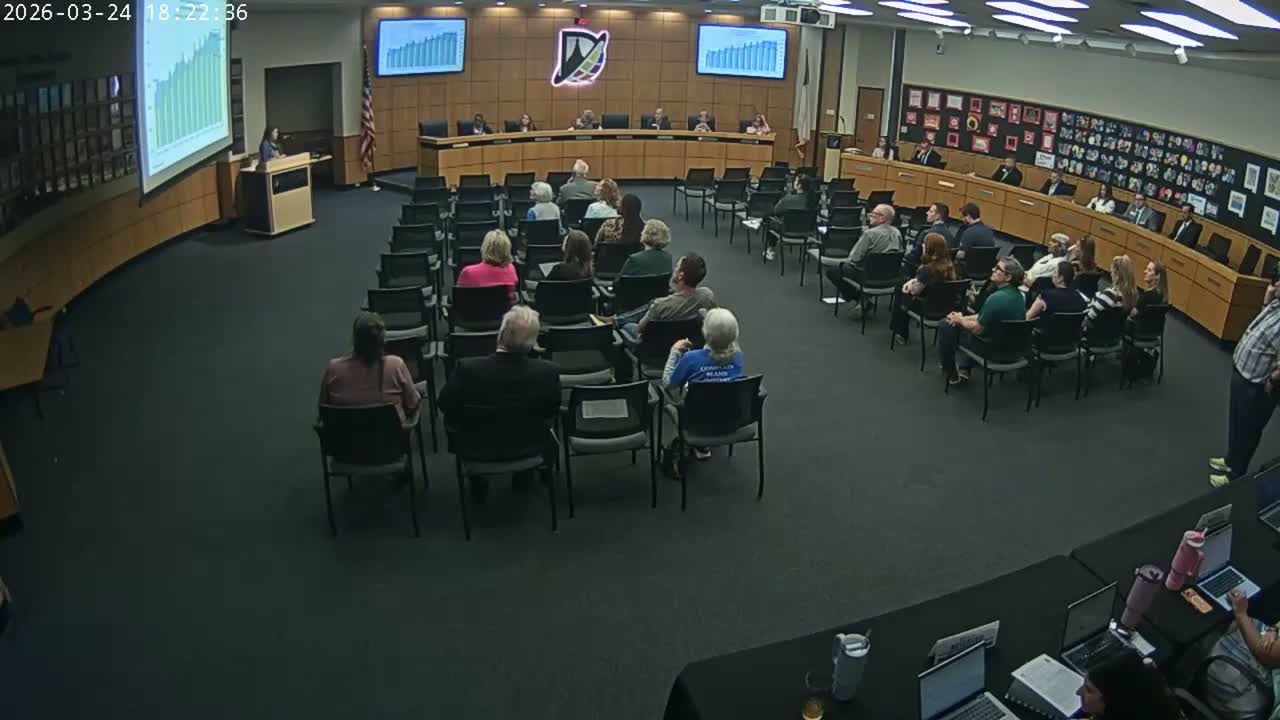
At the board workshop, Jennifer Stewart reviewed ten years of enrollment and attendance data to set planning assumptions for next year’s budget. She said enrollment has steadily increased while attendance (average daily attendance, ADA) has not kept pace; for the 2026 budget the district set ADA at 30,800, based on a 94.5% attendance assumption. Stewart cited an October snapshot attendance of 95.43% and noted the district's fourth-6-weeks ADA of 94.59% — the highest fourth-6-weeks percentage in several years.
Stewart called attention to pre-K growth, which rose from about 838 to about 1,513 students over the past decade; because pre-K is funded at half-day rates, the district must account for that when projecting weighted ADA (WADA). She also described changes arising from House Bill 3 and other recent legislation: the early-education allotment was described as increasing (presentation cited a shift from about $3.9 million toward roughly $5.4 million in additional funding), CTE funding rose (staff cited growth from about $22.4 million to $24.4 million tied to more students in approved CTE courses and counting junior ROTC as CTE), and the special-education allotment was projected to increase by about $2.3 million year over year driven by rising special-education counts and methodology changes to funding.
Stewart warned that the Fast Growth Allotment is tiered and that district placement among tiers depends on growth compared with peer districts; Denton ISD was noted as 13th of 18 in its tiering comparison and could face a lower allotment tier if peer districts grow faster. She said the district is monitoring enrollment dips and new variables that will complicate 2026–27 budgeting, including possible voucher impacts and the launch/scale of Denton Digital.
Board members asked clarifying questions about early-childhood expectations tied to additional funding (teacher requirements and program obligations) and how Denton Digital interest and transfer windows could influence next year’s counts. Stewart and other staff said they will continue updating the board as transfer windows close and more Denton Digital interest data are collected.