Get Full Government Meeting Transcripts, Videos, & Alerts Forever!
Get email alerts on the Community Services Facilities topic
No spam. Unsubscribe anytime.
Panel approves Catonsville Emergency Assistance building with conditions to improve access and compatibility
Summary
The Baltimore County DRP approved a plan to demolish 25 Bloomsbury and build a 1,913-square-foot service building behind 23 Bloomsbury for Catonsville Emergency Assistance, subject to staff‑administered conditions including a sidewalk connection to Bloomsbury Avenue, reduced parking to improve pedestrian flow, and material/styling studies to better match the existing building.
The Baltimore County Design Review Panel on April 8 approved with conditions a plan to replace the building at 25 Bloomsbury Avenue and add a new single‑story service building behind 23 Bloomsbury for Catonsville Emergency Assistance (CEA), with the applicant asked to refine site access, materials and compatibility with the existing building.
Jessica Campbell, a landscape architect with Frederick Ward Associates, introduced the project on behalf of CEA and said the organization provides “food assistance, utility cutoff prevention, and eviction prevention assistance,” and that the goal is to integrate both properties, improve circulation and storage, and better serve clients. The proposal calls for demolishing the existing building at 25 Bloomsbury and constructing a roughly 1,913‑square‑foot single‑story building behind the existing structure at 23 Bloomsbury; the team said an ALJ zoning hearing in January 2026 granted relief for reduced setbacks and the plan proposes the granted dimensions.
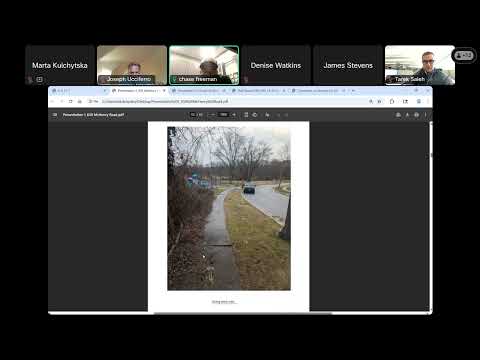
Department of Planning staff read a recommendation for approval of form and image with specific comments: provide a pedestrian circulation diagram and a safe sidewalk connection from Bloomsbury Avenue to the main entrance; clarify any additional variance requests; enhance landscape screening for the parking area (evergreen native shrubs recommended); and incorporate architectural elements on the north elevation to avoid a blank wall visible from the street. Panelists discussed how most clients access CEA (walking and transit), noted limited hours and scheduled pickup windows, and recommended reducing a few parking spaces to provide better sidewalk width and pedestrian relief. CEA’s representative (Mister Dempsey) said the organization typically schedules pickups and expects few people waiting outside.
Panel members also urged the applicant to study ways to tie the new building to the existing structure architecturally — suggested measures included considering a gray or reddish shingle to echo the older building’s roof, adding some higher windows or other articulation on the north and south facades, and exploring a modest base material such as a CMU or stone band for durability and visual transition. The project team emphasized budget constraints (grant funding and donations) but agreed to bring design adjustments for staff review.
Mister Walters moved to approve the project with conditions (consistent with the staff report and including a sidewalk connection to the public right-of-way on Bloomsbury Avenue, reduction of a few parking spaces for pedestrian relief, study of siding color/materials and compatibility with the existing building, and study of roof-shingle color); Mister Khan seconded. The panel voted to approve with those conditions and authorized administrative coordination with Department of Planning staff.
Next steps: the applicant will address the DRP and staff conditions administratively and return to permitting. Department of Planning will confirm any outstanding variance requirements and the pedestrian connection details during plan review.