Get Full Government Meeting Transcripts, Videos, & Alerts Forever!
Get email alerts on the Housing Preservation topic
No spam. Unsubscribe anytime.
Alamosa City staff outline pilots to preserve aging homes, propose 0% loan and targeted repairs
Summary
Development services presented a housing-action follow-up focused on repairing dilapidated homes, bringing vacant properties back into use and testing two pilots (HUBS repairs and a 0% loan). Staff described a theoretical voter-funded —blight— tax as a last-resort funding option and said details and timelines will return for approval.
Alamosa City development staff presented a plan to preserve existing housing stock and pilot two programs aimed at keeping residents in aging homes. At a work session, staff described a HUBS (Housing Upgrades to Benefit Seniors) pilot and a 0% interest loan program aimed at low- and moderate-income homeowners, and outlined options for acquiring or rehabilitating vacant properties.
The presentation, opened by the meeting chair and presented by development services staff, framed the plan as a high-level roadmap funded by a February 2024 Division of Housing grant and consultant work. The presenters said the HUBS pilot would act like a city-coordinated general contractor for targeted repairs such as reroofing and weatherization, with the aim of delivering 5— projects a year to achieve measurable progress. "One of the things we want to do is take rundown homes back into the housing stock," the presenter said, describing the focus on seniors and residents who lack the physical capacity or financial means to complete repairs.
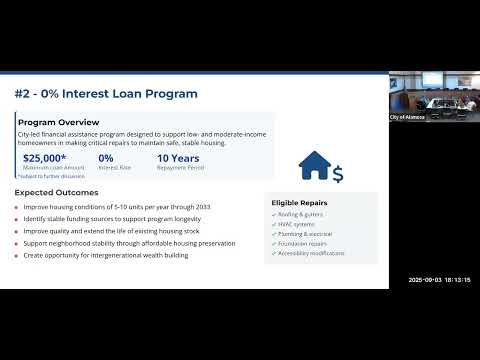
Staff also proposed a 0% interest loan pilot for eligible households to pay for repairs they otherwise could not afford. The proposal referenced a tentative cap figure that staff flagged for further discussion: "I have my big asterisk there, that $25,000, subject to future discussion," a presenter said. Staff said the loan program would require seed money from foundations, grants or partner banks and could become self-sustaining through repayments, not by drawing on the citys general fund immediately.
On vacant and foreclosed properties, staff highlighted CHFAs First Look program and described outreach to lenders as a necessary, often difficult step. "Sometimes these homes are just a number on a banks books but can still be salvaged," the presenter said, urging continued negotiation with lenders and community groups to return properties to productive use.
The presentation named a third, more theoretical option: a voter-approved blight tax to fund remediation for absentee-owned or severely neglected properties. Staff gave a worked example to show scale: at a 25-mill equivalent rate they described, the additional tax would be roughly $1,000 per $100,000 of assessed value (about $2,000 for a $200,000 property). Staff emphasized this was a least-developed idea that would require substantial legal work, careful definitions of "blighted" property, and would be considered only as a last resort.
Councilors pressed staff on mechanics and optics. Councilor Carson asked who would hold a lien for loan repayment; staff responded that some form of lien or protective instrument would likely be necessary but that placement and legal collection priority would need to be carefully designed. Concerns about enforcement optics were raised: councilors noted the risk that ramped-up code enforcement without clear supports could create public backlash.
Several councilors and staff emphasized a triage approach: prioritizing roof repairs and other interventions that buy time and prevent structural collapse. Building and historic-preservation staff said the city can help homeowners navigate inspections, realistic cost estimates and contractor selection to reduce the risk of poor workmanship and unexpected scope creep. "If we can get that roof replaced, then we can at least buy some time," a presenter said.
A resident during public comment asked whether the blight-tax option would be a "back pocket" last resort and how income eligibility would be defined; staff reiterated the tax would be last-resort and that qualification details (poverty threshold vs. set income limits) have not been finalized.
Next steps: staff recommended piloting the HUBS repairs and the 0% loan first, returning with more detailed timelines, implementation responsibilities and funding plans in a future work session. No formal votes were taken at the work session.
The work session closed with the chair thanking staff and asking for follow-up on the legal and programmatic questions raised by councilors and the public.