Get Full Government Meeting Transcripts, Videos, & Alerts Forever!
Get email alerts on the Behavioral Health topic
No spam. Unsubscribe anytime.
County mental‑health leader outlines new local facilities and warns 6,500 residents could lose benefits under federal changes
Summary
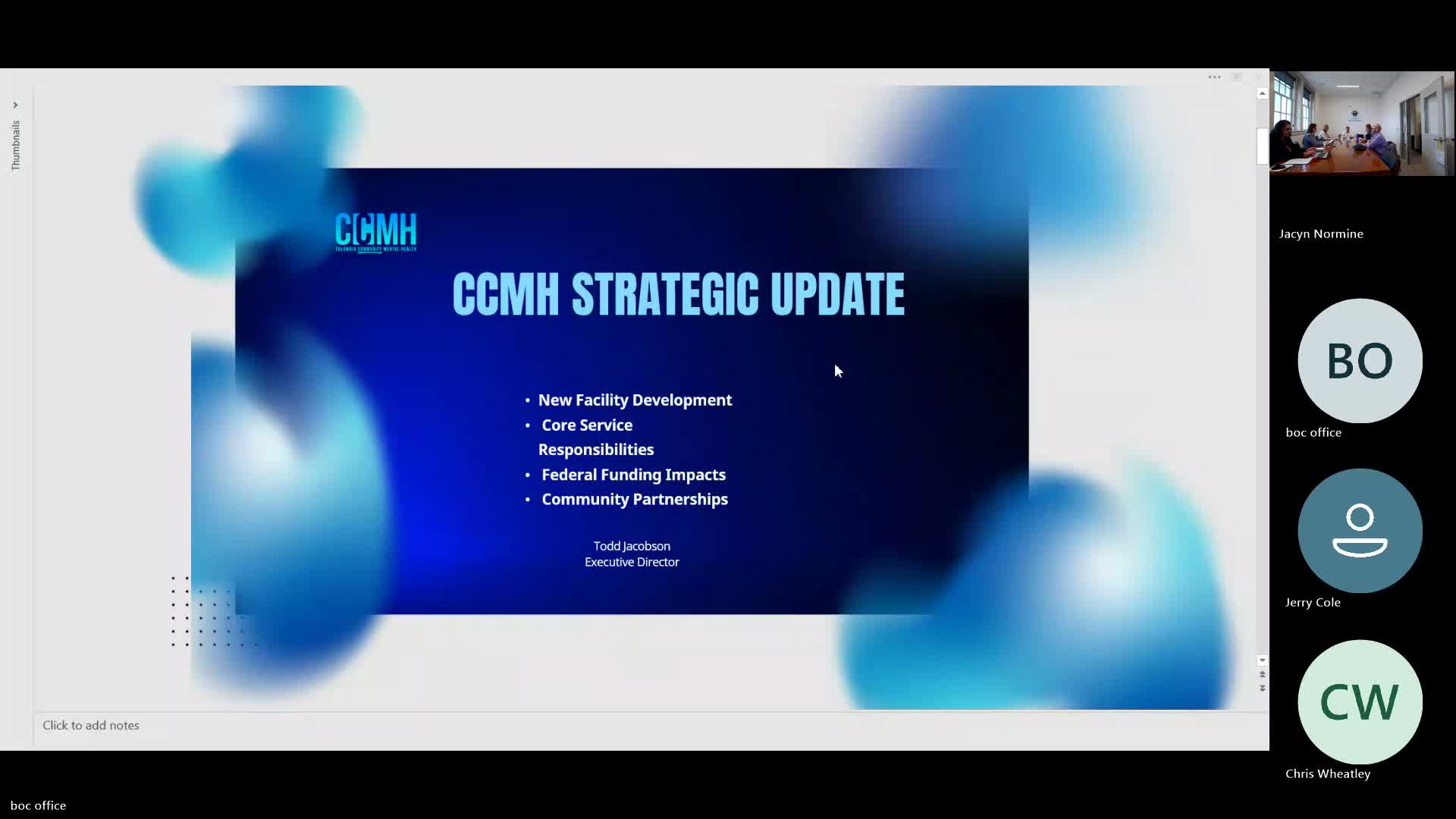
Chad Jacobson of Columbia County Mental Health Services described plans for a 16‑bed SUD residential move, a 10‑bed detox and an adult/youth crisis stabilization unit, estimated the project at about $7.5 million (90% grant funded), and warned that proposed federal eligibility changes could put about 6,500 residents at risk of losing enhanced coverage.
Chad Jacobson, representing Columbia County Mental Health Services, told county commissioners that the agency is moving a 16‑bed substance‑use‑disorder residential program from 4th Street to the main CCMH campus and building supplemental facilities including a 10‑bed detox unit and a crisis‑stabilization center with five adult and three youth beds.
Jacobson said the new residential site will offer private rooms and be within walking distance of outpatient and group therapies at the campus to improve continuity of care. He described the crisis‑stabilization unit as an unlocked facility with a separate law‑enforcement entrance required by rule and emphasized a clinical design limit: "we can't keep anyone more than 24 hours in this facility," he said.
The presenter said the county also plans a transitional supported‑living program of roughly 16 beds and a 90‑day transitional housing component commonly used for court referrals. Jacobson described CCMH's forensic and involuntary‑services role: staff perform competency‑restoration assessments when courts order them and, if local restoration isn't possible, refer individuals to the Oregon State Hospital.
Jacobson warned that proposed federal policy changes (discussed as "HR1" in the presentation) would add work or volunteer requirements, change redetermination cadence and limit retroactive coverage. "All this combined ... we're gonna see people fall off the rolls," he said, estimating roughly 6,500 Columbia County residents currently covered under an enhanced benefit package could be at risk of losing that coverage. He urged planning for an initial community partner meeting at month’s end to coordinate supports if coverage shrinks.
On capacity and access, Jacobson said CCMH generally does not accept out‑of‑county patients except for rare negotiated transfers within the Columbia Pacific coordinated‑care network; residential placements made elsewhere are monitored by CCMH and patients are expected to return to their county of responsibility when appropriate. He provided bed counts for residential programs (approximately 16, 9 and 16 beds) and said some clients are being monitored while placed in out‑of‑county facilities.
Jacobson described workforce pressures as a critical constraint: the agency lacks enough credentialed clinical staff, recruitment is weak and staffing shortfalls threaten service delivery and revenue. He estimated the full capital project at about $7.5 million and said roughly 90% of that amount is expected to come from grant funds.
The presentation closed with a commitment to host an open house when construction finishes and a request to coordinate community partners to prepare for potential coverage losses and service demand shifts.