Get Full Government Meeting Transcripts, Videos, & Alerts Forever!
Get email alerts on the Courthouse Renovation topic
No spam. Unsubscribe anytime.
County, senator and state courts dispute the scope of $2 million courthouse appropriation; parties agree to scoping study
Summary
Sen. Suzanne Weber told Columbia County commissioners the $2 million legislative appropriation for courthouse renovation was intended broadly; Oregon Judicial Department officials said the funds were allocated to OJD’s courthouse improvement program and should directly benefit courts. Commissioners agreed to commission Hart Architects to scope two renovation options so costs can be compared before a month-end decision.
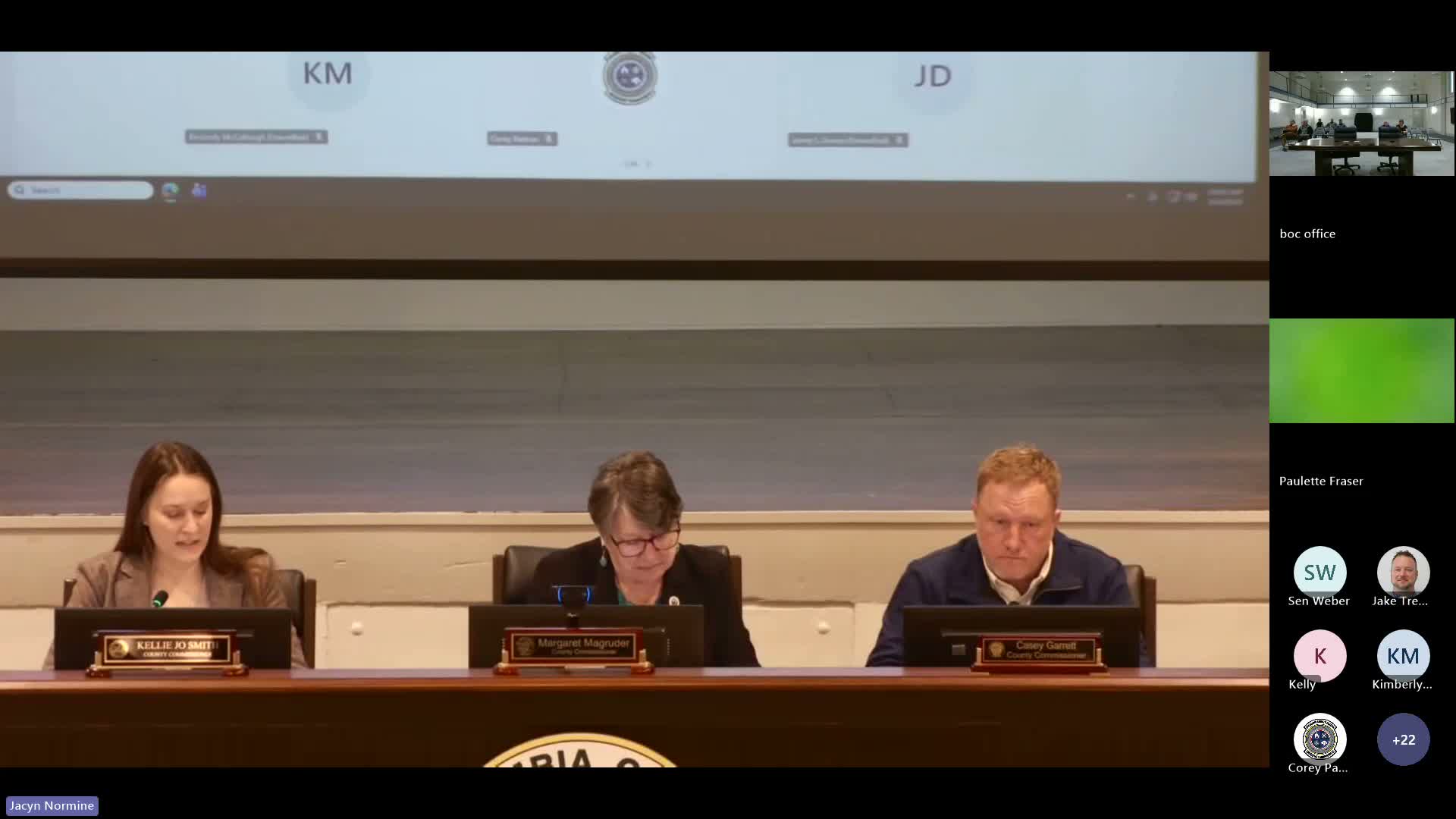
Sen. Suzanne Weber urged Columbia County commissioners on Feb. 4 to move quickly to use a $2 million state appropriation for courthouse renovation, saying legislative counsel found the appropriation language broad and not limited exclusively to circuit-court-only projects. "The appropriation language is clear and broad," Weber said, adding the funding was intended to support flexible courthouse improvements that serve justice, county operations and historic preservation.
Representatives of the Oregon Judicial Department (OJD) disagreed on the allowable uses. Kimberly McCullough, senior counsel for government relations at OJD, told the board the money was placed in OJD’s courthouse improvement program and that agency policy is to spend such funds for the “direct benefit of the court.” McCullough said OJD does not view renovating a county office for the district attorney as an appropriate use of funds allocated to OJD. "Any agreement we reach with the county regarding the use of the $2,000,000 allocated to the Oregon legislature for courthouse improvements must be used for the direct benefit of the court," she said.
Jessica Rozier, deputy state court administrator, urged a pragmatic next step: scope both Plan A (third-floor courthouse renovation) and Plan B (second-floor renovation) so the county and OJD have concrete cost and design comparisons. "Scoping out both Plan A and Plan B will give us hard facts and numbers to evaluate," Rozier said, adding that scoping does not commit either party to proceeding with construction.
County counsel Sarah Hansen said the county cannot expend the funds until the county and OJD jointly agree on a scope of work and proposed amending the intergovernmental agreement to authorize scoping both options. Commissioners stressed urgency: staff and officials estimated about $25,000 and 10–12 weeks for Hart Architects to complete a feasibility/scoping report for both plans. County staff cautioned that the scoping study will produce conceptual plans only; a separate estimator would be needed thereafter to produce hard construction costs.
Commissioners argued that some renovation work would enable the county to consolidate offices (for example, returning land development services to county-owned space) and avoid ongoing rent of roughly $6,000 per month for leased space. Several commissioners said that without the ability to use some funds to renovate county operating space the county could not realize the full benefit of the proposed courthouse reconfiguration.
The board directed staff to draft an amendment that would authorize Hart Architects to scope both Plan A and Plan B, include deliverables that list options and conceptual costs, and return the amendment to the board before the end of the month. OJD representatives agreed scoping both options would help end the impasse, though they reiterated that final use of any funds must comply with OJD’s program parameters.
What happens next: commissioners and OJD will use the scoping report to negotiate a final scope and a potential amendment to the existing intergovernmental agreement; if parties cannot agree the county may pursue reallocation through legislative or administrative channels. The board was warned the scoping study is an intermediate step and does not authorize construction spending.