Lifetime Citizen Portal Access — AI Briefings, Alerts & Unlimited Follows
Moses Lake council weighs survey results and revenue/cut scenarios as forecast shows widening deficit
Loading...
Summary
At a lengthy study session, consultants presented a statistically valid survey (300 responses) showing high voter priority for emergency response and water and strong support for a 0.1% public-safety sales tax (reported 73%). Staff and consultants ran live forecast scenarios showing deficits through 2031 and tested revenue options (property tax 1% capacity, sales taxes, MPD) and program reductions including possible changes to the Larson Rec Center, Surf and Slide, museum and parks.
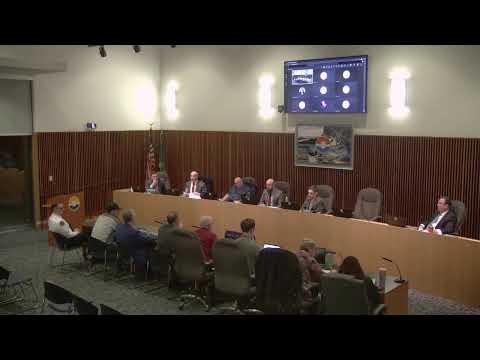
City staff and outside consultants spent the bulk of the meeting presenting community survey data and running live budget scenarios intended to close a growing multi-year budget gap.
Ian Stewart of Fulcrum Strategy Group summarized the statistically valid survey (300 completed interviews between March 18 and April 1, 2026) and walked council through methodology and results. Stewart said the margin of error is about 5.7 percentage points at the 95% confidence level for the full sample and noted larger margins for the three sub-geographies. When asked what is the most important problem the city should address, open-ended answers clustered on homelessness (17%), crime/drugs/public safety (17%), and infrastructure/roads. Stewart identified two standout priorities in the forced-choice sections: fast fire and emergency medical response and a sustainable, reliable water source.
On fiscal trade-offs, the survey presented voters with options to close the budget gap. Stewart said the plurality of respondents prefer a combination of service cuts and tax increases rather than one single approach. Notably, the survey showed 73% support for a 0.1% sales-tax measure directed to policing/public safety operations; Stewart cautioned that phone-survey topline support does not always translate one-for-one at the ballot box. A separate question about a 0.1% cultural/cultural-access sales tax drew lower but substantial support (reported 56%).
Jeff Pooley with Next Level Analytics demonstrated the forecast and live toggles. The consolidated general-and-street-fund projection showed reserves eroding and cumulative deficits increasing through 2031 under current policies. Pooley and staff walked council through model levers: a 1% annual councilmanic property-tax increase (roughly $100,000 per year), accessing banked levy capacity (~$1M), a Metropolitan Park District (MPD) at the 50 ¢ tier (approx. $2M) or up to 75¢ for added revenue, a 0.1% public-safety sales tax (modeled at ~$1.2M), a 0.1% cultural sales tax, incremental fee and permit cost recovery, and program reductions for enhanced services.
Council discussed enhanced-program options at length. Staff identified the largest net negative program impacts as the Larson Recreation Center (a large net cost, including debt service), Surf and Slide Waterpark (high operating cost, positive but limited revenue), recreation programs, the museum and the ice rink. Options included: (a) seeking a third party or non-profit operator for Larson, (b) phased reductions or fee increases in Surf and Slide, (c) moving museum support to a dedicated cultural-sales-tax and partnering regionally, and (d) gradually reducing parks-maintenance obligations by reclassifying low-use parcels, increasing volunteer stewardship and changing mowing regimes.
Council members pressed for impact analyses before adopting deep, immediate cuts to parks: staff warned a sudden 30% cut to the parks budget (presented as an illustrative scenario) would have substantial operational impacts and that many maintenance costs are fixed or embedded in debt and contract obligations. Council discussed a graduated approach (e.g., phased percentage reductions over several years), simultaneous work on revenue measures (public-safety sales tax, MPD), and agreed to ask staff to return with department-level, phased impact assessments and alternative scenarios for the April 20 meeting.
On emergency-medical transport reimbursements and the ambulance utility, council asked fire department leadership and finance to pursue higher collection rates and maximize GEMT (Ground Emergency Medical Transport) reimbursement; staff estimated a realistic near-term target of additional reimbursements in the low hundreds of thousands, with higher numbers possible but not guaranteed.
Next steps: staff will return with a set of clear scenarios (aggressive enhanced-program reductions, phased cuts, and voter-revenue measures with implementation timing) and department-specific impact statements to support council decisions at the next scheduled meeting.