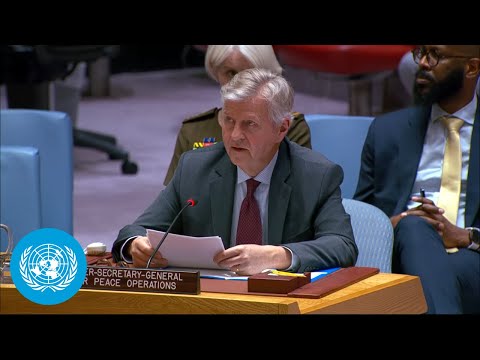
Jean-Pierre Lacroix urges stronger support and adaptability for UN peacekeeping
Loading...
Summary
Jean-Pierre Lacroix told the Security Council at the 2026 Conference of the Military Component that UN peacekeeping must be more adaptable, better resourced and performance-driven, citing technology, partnerships and recent operational constraints; he also honored peacekeepers killed in recent missions.
Jean-Pierre Lacroix told the Security Council that UN peacekeeping must become more adaptable and better resourced to meet evolving threats and sustain protection mandates. He spoke at the 2026 Conference of the Military Component and introduced two accompanying force commanders from MINUSCA and UNISFA.
Lacroix said the Secretary-General has commissioned an evaluation under the "pact for the future" that will propose recommendations to member states on adapting peacekeeping operations. He described the new iteration of Action for Peacekeeping (A4P) Impact as retaining “a strong focus on performance,” including new evaluations for infantry battalions to identify shortfalls and guide corrective action.
He argued that mandates should be prioritized, focused and adequately resourced, and that troop- and police-contributing countries must be included in mandate design. "UN peacekeeping is and remains a useful political tool used by the international community to help parties to put an end to armed conflict and move towards lasting peace," Lacroix said. He added that "the protection of civilians will remain a priority everywhere where it is mandated."
On capabilities, Lacroix emphasized both enhanced mobility and digital transformation. He noted data-driven tools, integrated command and control, and technologies such as drones, satellite imagery and artificial intelligence can strengthen situational awareness, early warning and force protection. "Technology alone is not a solution," he cautioned, saying such investments must be paired with skilled personnel, sustained training and predictable resources.
Using MONUSCO as an example, Lacroix said missions have adopted layered surveillance approaches to cope with armed drones and GPS interference. He warned that recent contingency measures taken in response to financial shortfalls — including base closures and reduced aviation hours — have reduced situational awareness and early-warning capacity, limited proactive intervention and increased reliance on higher-risk ground movements.
Lacroix urged member states to meet assessed contributions on time, saying missions were identifying efficiencies but that predictable funding remains essential to deliver mandated political and protection tasks. He also underscored partnership with regional organizations, calling the African Union central to the vision for more coherent, predictable support to African-led operations and referencing implementation of Resolution 2079 as a priority.
He closed by paying tribute to peacekeepers who had recently lost their lives in the line of duty: he named three Indonesian peacekeepers serving with UNIFIL and six Bangladeshi peacekeepers killed while serving with UNISFA. The presiding officer thanked Lacroix for his briefing.
The Council did not take a vote during this briefing; Lacroix outlined forthcoming evaluations and a set of recommendations for member-state consideration.