Senate approves broad 'democracy and government accountability' measure, prompting heated debate over federal authority and public‑safety tradeoffs
Loading...
Summary
Senate Bill 397 (a strike‑all substitute) passed after an extended floor debate and multiple amendments. Supporters said it protects residents' constitutional rights from federal overreach; opponents warned of Supremacy Clause conflicts, operational impacts on federal and local law enforcement, and unintended public‑safety effects.
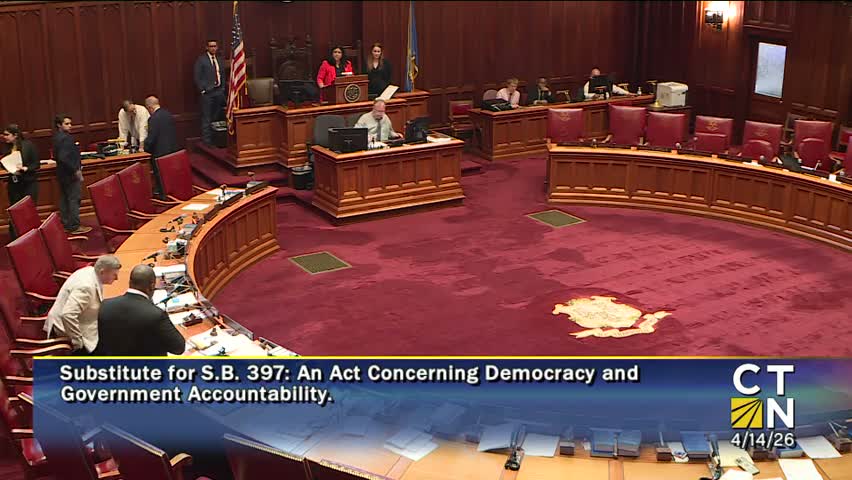
The Connecticut Senate passed a strike‑all substitute to Senate Bill 397 on April 14 after hours of floor debate over federal authority, civil‑rights remedies, officer identification and limits on federal enforcement activities.
Senator Winfield, sponsor of the amendment that became the bill (LCO 4084), described the measure as creating state‑level remedies and clarifying enforcement when federal actors operate 'under color of law' in the state. He said the bill would add a private cause of action in state courts, expand authority for the attorney general and inspector general in certain circumstances, address training and immunity issues, and include provisions on mask‑use and officer identification.
Opponents argued the legislation attempts to regulate federal agencies and would likely be challenged on Supremacy Clause grounds. Senator Kissel warned it could impede the FBI, ATF, DEA and Secret Service; Senator Sampson and others said existing constitutional remedies already exist and cautioned the bill could encourage litigation and undermine law‑enforcement recruitment. Supporters, including Senator Winfield, Senator Looney and several Democrats, framed the bill as a protection for residents whose constitutional rights could be violated and pointed to recent events elsewhere and testimony from communities experiencing disruption.
Key floor maneuvers: the Senate adopted the strike‑all substitute (amendment A) by roll call; a technical amendment (amendment B, LCO 4114) clarifying data retention and cloud storage was adopted by voice vote. Senator Fazio’s amendment C (LCO 4100) to carve out exigent detentions of persons convicted of serious felonies so federal authorities could act in those cases was debated and failed on roll call.
Legal and procedural questions dominated debate: senators cited cases (Bivens, Westfall, McCulloch v. Maryland and Arizona v. United States among others) to argue whether the state can create the remedies the bill contemplates. Proponents argued the bill does not change immigration policy but provides remedies under state law when constitutional rights are violated; opponents said many sections would be struck down and leave unintended effects on state and local policing.
Final vote: the clerk announced the tally on the bill as amended — total voting 34; recorded votes 24 yes, 10 no; 2 not voting — and the legislation passed. Sponsors said implementation details and interactions with federal law remain subject to judicial review.
What’s next: With Senate passage, SB 397 moves to the House; sponsors and critics alike expect litigation over preemption and constitutionality if enacted.