Get Full Government Meeting Transcripts, Videos, & Alerts Forever!
Get email alerts on the School Policy Review topic
No spam. Unsubscribe anytime.
Conewago Valley SD policy subcommittee advances 700‑series updates, declines to reinstate pandemic-era language on health decisions
Summary
The Conewago Valley School District policy subcommittee reviewed and moved multiple 700-series policies forward — including facilities use, building/property security, and video surveillance — and voted against reinstating pre-pandemic language asserting parental primacy in health decisions, opting to retain the pre-pandemic operating policy.
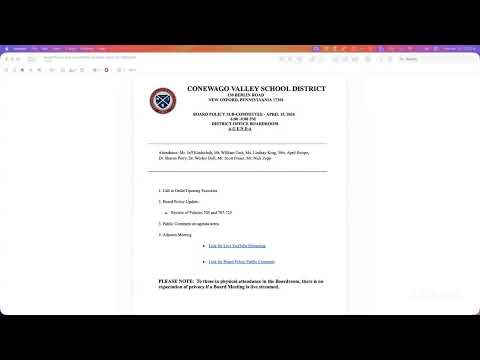
The Conewago Valley School District policy subcommittee met April 15 to resume review of its 700‑series policies and voted to advance recommended edits on a set of facilities and safety rules while declining to add pandemic-era language that would assert parental primacy over health decisions.
Dr. Perry led the review of policies 707 through 725, telling the committee that policy 707 (use of facilities) had been held so the athletics subcommittee could review a proposed fee schedule. The subcommittee accepted minor wording corrections and asked for clearer blackout-date language; members also agreed to restore explicit reference to alcoholic beverages so the policy will read, as discussed, to prohibit “possession, use, or distribution of alcoholic beverages, controlled substances …” when appropriate.
On policy 708 (lending of equipment and books), the committee accepted rewording to make clear that district equipment “shall not be borrowed without previous written permission, nor shall it be used for financial gain.” Committee members said identical edits had been submitted independently and supported moving the policy forward.
Policy 709 (building security) prompted detailed discussion about scope and delegation of authority. Members debated whether the policy should address only structures or be broadened to “property” to cover stadiums, gates and parking lots. Dr. Perry explained that facility-use approvals are managed by the athletics department (the assistant athletic director handles day‑to‑day approvals) but that security is coordinated by the school safety and security coordinator in cooperation with district administration and building principals. The committee agreed to revise language so the superintendent or designee explicitly determines who is authorized to have after-hours access to district buildings and facilities.
The committee also amended the trespassing section to authorize “members of local and Commonwealth law enforcement agencies” — a change discussed to include Pennsylvania State Police in addition to local municipal departments that assist the district.
Members reviewed policy 709.1 (use of video surveillance) and tightened delegation language so that the superintendent (or designee) coordinates placement and use of surveillance systems, and any surveillance by outside parties is permitted only with superintendent authorization. The subcommittee confirmed a short list of district officers (superintendent, assistant superintendent, director of safety, director of transportation, director of technology, and school security officers) who may be authorized to view and control recordings.
Other items advanced with little substantive change: policy 710 (staff use of facilities), policy 716 (integrated pest management — records retained for three years and available at the district office), policy 717 (cellular telephones — the district maintains a list of issued phones and currently provides a $30 stipend to certain administrators), policy 718 (service animals, using a PSBA update), and policy 725 (security animals).
A lengthy exchange occurred over policy 705, which April requested be revisited to consider restoring pre‑pandemic wording that emphasizes the board’s recognition of parental authority over health-related decisions and references board‑approved health and safety plans. Supporters framed the change as an attempt to assert parental rights and to ensure families retain control in future public-health responses; one committee member described the proposed language as intended to prevent government overreach. Opponents — including administration representatives — cautioned that embedding detailed emergency-response measures into a general facilities policy could reduce the board’s flexibility to respond to unforeseeable future conditions and noted the district’s prior practice: during COVID the board approved a health and safety plan that the state reviewed and the district granted hundreds of waivers (the subcommittee noted 384 waivers were processed during the prior emergency period).
After discussion, the subcommittee voted to keep the pre‑pandemic wording on the district website (the administration’s recommendation) rather than adopt the proposed reinstated language; the committee said it would continue to address emergency health responses through separate safety plans or board actions as situations arise.
No public comments were received in person or online. The chair adjourned the meeting at 7:35 p.m.
What’s next: the subcommittee voted to move the recommended edits forward in the review process; administration will incorporate the wording adjustments and provide the athletics subcommittee’s fee schedule and a forthcoming annual safety report (in executive session) to the board.