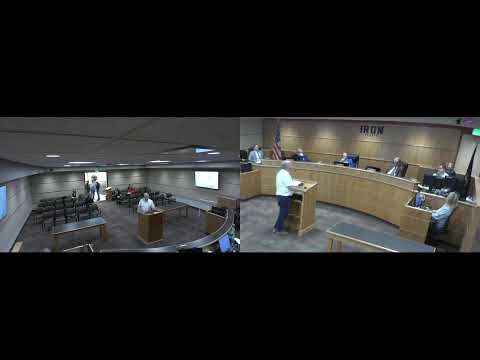
Residents press county on proposed data center's water, air and oversight as planning commission readies conditions
Loading...
Summary
Dozens of residents told Iron County commissioners they fear a proposed data center near Cedar City could strain water supplies, harm air quality and wildlife, and fail to deliver promised local jobs; commissioners and staff said draft conditions are being developed ahead of a May 7 planning-commission review.
A lengthy public comment period at the Iron County Commission’s April meeting focused on a proposed large data center on private land near Cedar City, with residents urging stricter oversight of water use, air emissions and wildlife protections and asking for clearer commitments on jobs and taxes.
Many speakers said they were skeptical of industry assurances. "I do challenge the idea that natural gas is clean," said Marianne Mann, a retired educator who called for the county to weigh health impacts for children and older residents. Riley Cooper, a Cedar City resident, said he was worried the county would be "seduced" by promised jobs and urged commissioners to keep the community’s long-term future in mind. Nicole Phillips asked the county to require ongoing, independent monitoring of air, water and animal health if the project moves forward.
County officials and staff said they are trying to address those concerns through the conditional-use permit (CUP) process that applies to data centers under county code. Brett Hamilton, county planner, told the commission that the county has drafted a set of impact-area conditions tied to the ordinance requirements in Chapter 17.37 of the Iron County code and that the planning commission will likely take the item up for a possible vote on May 7. "We are gathering input and tailoring conditions to address impacts," he said.
Commissioners who toured a large data center in Salt Lake County reported technical findings to the meeting: the model facility uses closed-loop glycol cooling (limiting water consumption compared with older designs), has diesel generators only for backup and extensive fire suppression and isolation systems. A commissioner who attended the tour said staff ran decibel tests and found exterior noise to be minimal. Still, speakers in the audience pointed to cases elsewhere where measured water use, number of backup generators, and actual staffing levels differed from initial industry claims.
Water rights were repeatedly cited as the county’s central constraint. County staff noted that local basins are largely allocated and that any project would need to secure water rights on the open market or work through the Central Iron County Water Conservancy District. Commissioners and staff urged residents to submit questions and supporting data to the county’s planning staff, saying public input has already shaped draft conditions.
On jobs, presenters said a data-center operator told commissioners that a headquarters-style facility would directly employ a modest operations staff (the visiting facility cited about 40 on-site technicians) while the bulk of jobs would come from client firms and contracted service providers. Some members of the public questioned how many of those positions would go to local residents.
No final action on the data center was taken by the commission. The county reiterated that the planning commission, which handles CUP decisions under state law and local code, will be the body to recommend approval or denial; the county commission said it will remain engaged and help ensure conditions and reporting requirements are enforceable. The planning staff said the next public hearing before the planning commission is expected May 7, when draft conditions and the staff report will be posted for review.