Lake County committee approves forwarding new logistics‑facility rules to County Board
Loading...
Summary
The committee approved forwarding amendments to the Unified Development Ordinance that add definitions and use standards for logistics facilities in unincorporated Lake County, including size thresholds, increased setbacks from sensitive receptors, landscaping and environmental study requirements; the committee also approved a FEMA‑funded $41,043.83 emergency appropriation for a stormwater risk assessment.
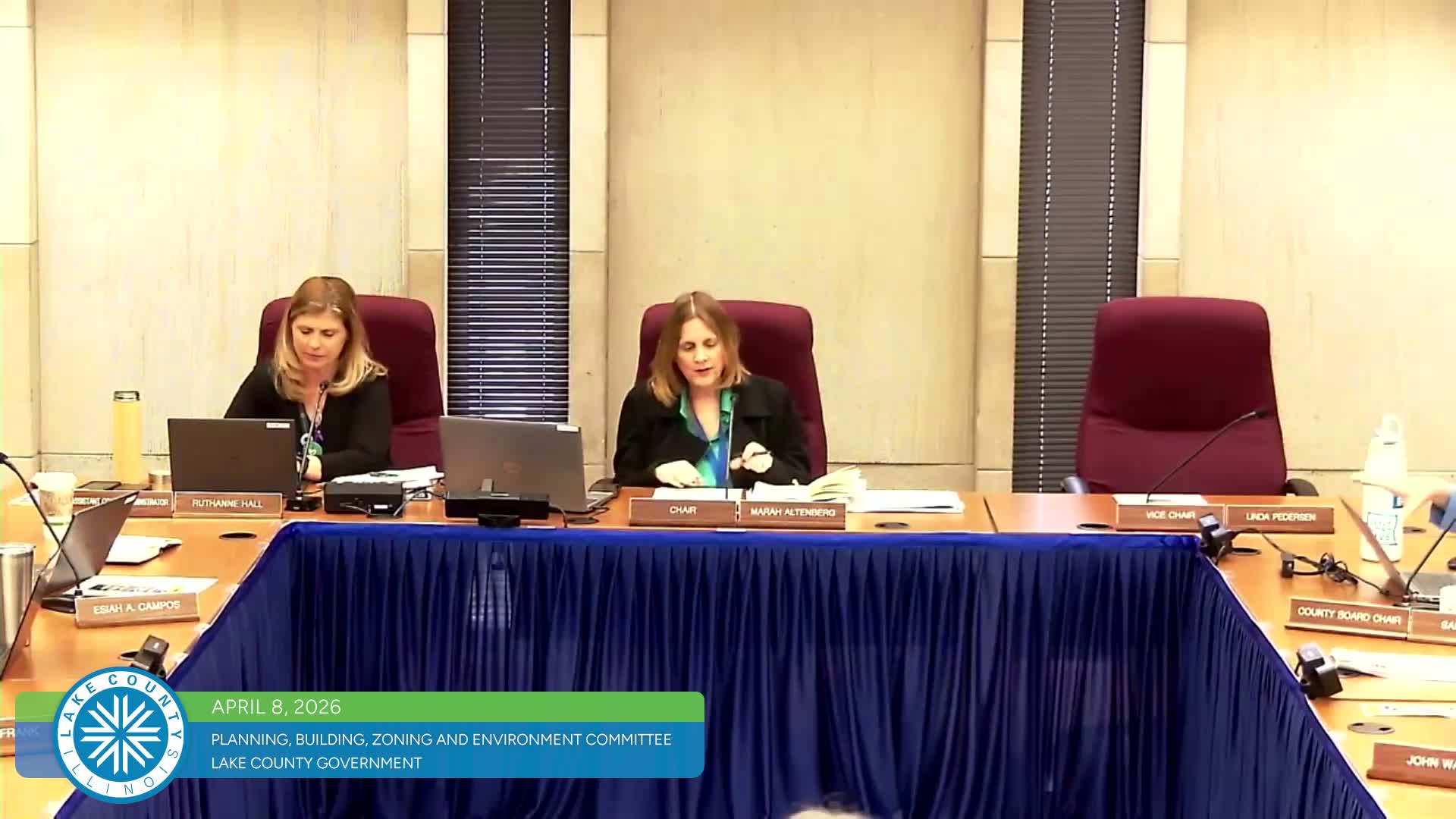
The Lake County Planning, Building, Zoning & Environment Committee on April 8 voted to forward a package of amendments to the county's Unified Development Ordinance addressing logistics facilities to the County Board for final action.
Planning Director Eric Wagner introduced the package and said the changes respond to the recent growth in e‑commerce and the distinct land‑use impacts of distribution and fulfillment centers. "Lake County code currently does not have specific standards for logistics facilities or centers," planner Natalia Fick told the committee. The amendments add a new logistics‑facility definition and create separate standards for small and large logistics facilities.
Under the proposal, a small logistics facility would be 50,000 square feet of gross floor area or less and would be reviewed by the Zoning Board of Appeals. Facilities larger than 50,000 square feet would be subject to conditional use review by the County Board. Proposed standards include prohibiting new impervious surfaces in regulated flood plains, requiring a parking study, and increasing loading‑dock setbacks from "sensitive neighboring land uses" to 250 feet for smaller facilities and 500 feet for larger facilities. For large sites, applicants must provide an operating‑standards, environmental and community impact analysis.
On environmental review, Wagner said the ordinance requires an environmental study whose scope will be defined by the department. "The content of the environmental study is up to us... the scope of that environmental study is defined by the department," Wagner said, adding that the director has discretion to require more detailed analysis for larger projects.
Committee members sought clarifications. Member Wasik asked whether the ordinance prescribes specific environmental standards such as carbon‑footprinting or particulate emissions analysis; Wagner said the department would set the scope of each environmental study and could require more detail for larger projects. Member Frank asked how cumulative increases in impervious surface in an area would be addressed; Wagner pointed to existing impervious‑surface thresholds in the ordinance and said the conditional‑use process allows the county to impose stricter limits for sites that threaten environmental resources.
The committee also approved, by voice vote, an emergency appropriation of $41,043.83 to fund a structure‑specific risk assessment for the Nipressene Creek project in Grant Township. Sharon Ostrophy of Lake County Stormwater Management Commission said the project will partner with the Illinois State Water Survey and is funded through FEMA's Hazard Mitigation Grant Program and administered by the Illinois Emergency Management Agency.
Motion and next steps: The ordinance package was moved by Member Wasick and seconded by Member Frank; the committee approved forwarding it to the County Board, where final action is scheduled for April 14, 2026. The stormwater appropriation was moved by Member Frank, seconded by Member Campos, and approved by voice vote.
Why it matters: The amendments provide Lake County with a regulatory structure to review and condition logistics facilities in unincorporated areas and supply model language municipalities can reference. They also require environmental and community impact analysis for large facilities, giving staff and the County Board tools to address localized impacts of distribution centers.