Get Full Government Meeting Transcripts, Videos, & Alerts Forever!
Get email alerts on the Climate Action Plan topic
No spam. Unsubscribe anytime.
Lake County committee hears CMAP climate-action plan and unveils county model‑ordinance program
Summary
Lake County officials heard the Chicago Metropolitan Agency for Planning outline a regional Climate Action Plan that models an 86% emissions reduction pathway by 2050 and discussed how counties and municipalities can use CMAP tools. County staff also proposed a Sustainable Model Ordinance program to catalog and promote adoptable sustainability regulations.
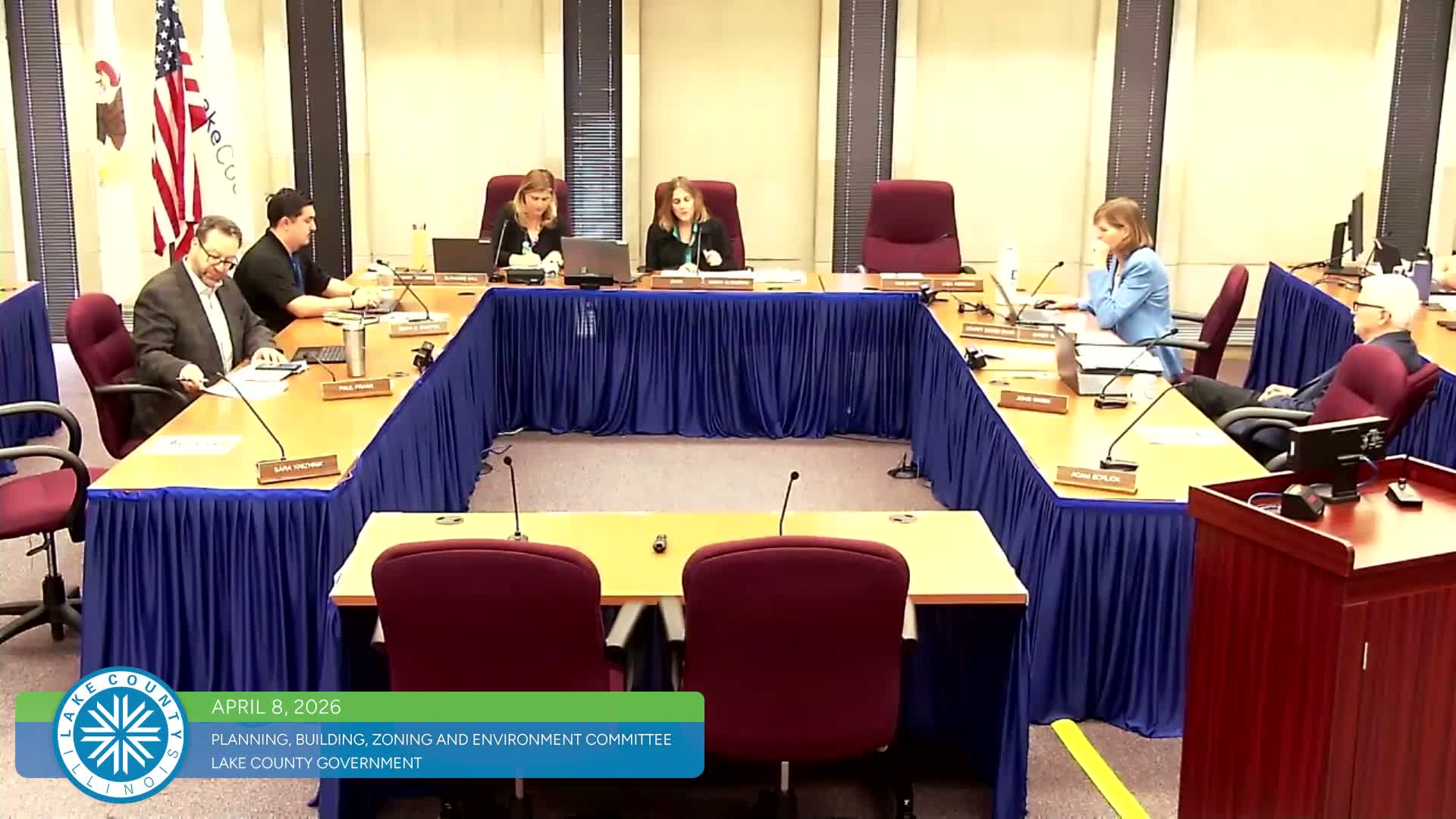
Lake County planning and environment committee members on April 8 heard a presentation from the Chicago Metropolitan Agency for Planning on a new comprehensive Climate Action Plan for the 13‑county Greater Chicago region and reviewed a county program to publish and promote sustainable model ordinances.
"This 13‑county region produces about 152,000,000 metric tons of carbon dioxide equivalent annually," Jesse Altman, a CMAP policy analyst, told the committee, laying out the region's inventory and targets. Altman said the plan sets a long‑term reduction objective of roughly 80–85% by 2050 and that a full‑implementation scenario modeled by CMAP could achieve an 86% reduction in emissions by midcentury.
The plan organizes action around six core strategies: clean and modernize the electric grid; improve building efficiency; shift building heating off fossil fuels; reimagine mobility; electrify vehicles; and decarbonize industry. Altman described steps counties and municipalities can take on building performance, transit investment, and local land‑use decisions that support those goals.
Committee members pressed CMAP on local application. "How could CMAP help the county achieve these goals outside of our jurisdiction?" asked Member Wasik. Altman said CMAP works with counties and municipalities and can provide data, outreach, and tailored technical assistance through partnerships such as the Metropolitan Mayors Caucus.
County sustainability programs manager Robin Grama presented a separate but related initiative: a Sustainable Model Ordinance (SMO) engagement program. Grama said the program would catalog county sustainability ordinances in an online inventory, notify public partners, survey municipal interest, offer technical assistance, and record municipal adoptions. "The idea is to showcase the regulatory sustainability efforts of the county to our public partners and residents," Grama said.
Grama described an implementation sequence: publish the completed inventory immediately, develop audience‑specific materials (two‑pagers and county profiles), ask departments for a "year‑ahead" list of regulations each November, and follow up with municipalities twice a year to record adoption progress. The program requires no formal committee action today.
Members expressed interest in concrete follow‑ups: Member Campos asked whether the committee has a baseline for the plan's goal to weatherize roughly half of residences; staff said they would follow up with available baseline data. Member Frank raised concerns about the energy impacts of data centers and whether CMAP's modeling accounted for that growth. Altman said the plan includes a callout on data centers and CMAP is tracking relevant legislation and modeling implications.
Why it matters: Committee members said the CMAP plan and the county's SMO program could help Lake County align local codes and investments with state and national decarbonization targets and provide ready‑to‑use ordinance language for municipalities with smaller planning staffs.
Next steps: CMAP said it will publish county profiles and a regional greenhouse gas inventory next year; county staff will post the SMO inventory on the county website and follow up with departments and municipalities as described.