Get Full Government Meeting Transcripts, Videos, & Alerts Forever!
Get email alerts on the Reserve Policy topic
No spam. Unsubscribe anytime.
Committee approves $46.3M capital reallocation amid debate over reserve policy changes
Summary
The committee approved a $46,276,796 reallocation of FY24 capital to the FY25 capital improvement fund and discussed proposed reserve-policy changes, including a recommendation that the general fund reserve be set as a range (proposed 29%–45%) while other property-tax funds move to a 16 2/3% requirement.
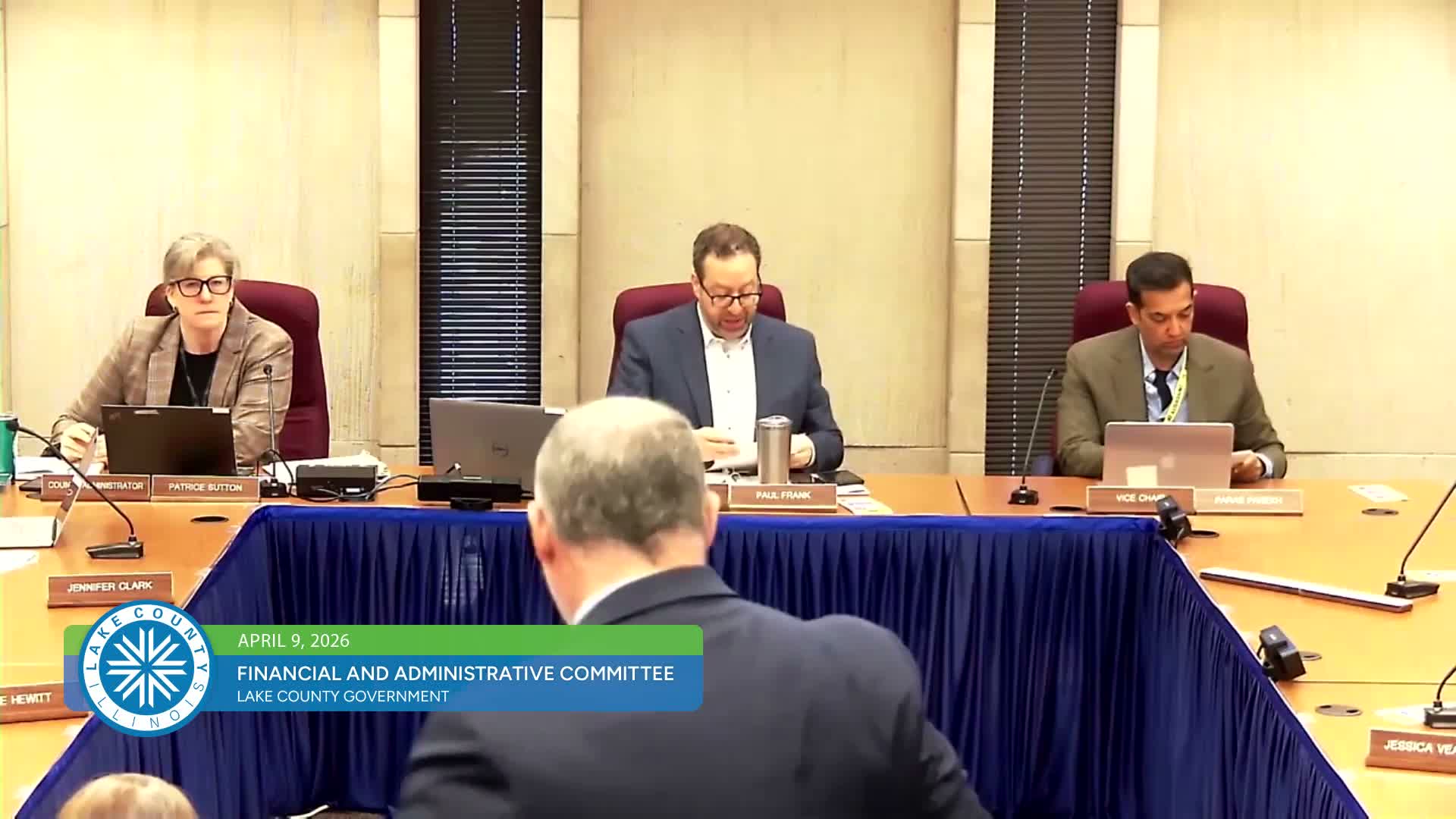
The Lake County Financial Administrative Committee on April 9 approved Resolution 8.2, reallocating $46,276,796 of FY24 capital into FY25 to address long-term capital needs and fund one-time capital investments, while also hearing a longer discussion about proposed changes to the county's fund balance reserve policy.
Regina Tuzak, the county's chief financial officer, presented the reallocation request and walked members through how excess reserves are calculated under policy 3.2. Tuzak said the county's policy requires undesignated reserves equal to a percentage of the next year's budget and described factors such as actuarially required reserves for claims, carryovers, and undesignated reserve minima.
Tuzak also brought four conceptual changes for the committee's consideration: evaluate and maintain each fund's excess reserves separately rather than aggregating them; adopt a general fund reserve range (a proposed illustrative range was 29% to 45%); set other property-tax funds at a 16 2/3% (two months) required reserve; and refine calculation elements to exclude reimbursable grant carryovers. "If we were to implement some or all of these concepts," Tuzak said, the required fund balance totals would look different and staff would return with precise calculations.
Committee members pressed on practical implications: whether lower reserves in some funds would affect the county's bond rating, the potential to accelerate capital projects if excess reserves are reallocated to capital, and the mechanics for choosing where in a range the county should sit each year. The county administrator noted the county plans to use cash to fund immediate needs until a 2028 bond falls off, after which the county could return to bonding for capital.
Members also emphasized maintaining flexibility for human services in the event of looming federal funding changes. One member said the proposal should be considered carefully in the FY27 budget process so the county can balance operating contingencies with capital needs.
After discussion the committee approved the reallocation and emergency appropriation for FY24 capital by voice vote; CFO Tuzak said staff will socialize the policy concepts with departments and aim to return with formal draft language for committee consideration later this spring or early summer.