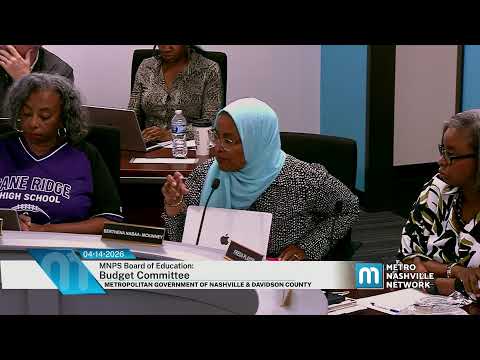
MNPS finance committee outlines FY27 continuity needs, confirms insurance and pension cost increases as board weighs 4% COLA push
Loading...
Summary
Metro Nashville Public Schools staff presented the proposed FY27 continuity and aspirational budget, reporting insurer-set increases (7.95% certificated; 16.8% support-plan) and an estimated $1.6 million pension uptick; board members pressed for details and several urged a 4% cost-of-living adjustment for employees.
Metro Nashville Public Schools officials on Wednesday told the finance committee that the district's FY27 budget work will focus first on "continuity of operations" costs needed to sustain current services and then on aspirational investments if additional funding is available.
Chief Robles, who led the presentation, said the district is incorporating insurer and pension board decisions into its FY27 planning. "Our insurance trust is 7.95%" for certificated plans and the Metro government support-employee plan is set at "16.8%," he said. Robles added the TCRS pension change will increase employer costs by about $1,600,000 given roughly 2,900 employees on that plan.
The committee was told those percentages represent the employer-side costs the district must budget; Robles clarified that MNPS typically covers about 75% of premiums for plans it administers, so employees will also see premium changes consistent with plan decisions. A board member asked whether the district or employees would bear the full increase; Robles said the figures reported were the employer portion the district must fund.
Why the discussion matters: the board needs to adopt an MNPS budget that the mayor and Metro Council will incorporate into the city's budget process. Robles noted the mayor's State of Metro address will set the allocation for the district and that a Metro Council budget-committee hearing is scheduled in May; MNPS will return to the board with a line-item budget for adoption once the city allocation is known.
Board members pressed staff on how the district divides its request between "continuity" (costs needed to maintain current services) and "aspirational" items (new investments designed to accelerate student outcomes). Robles said continuity-of-operations costs are the baseline the district must budget to sustain services given inflation and labor costs; he reported that continuity items total roughly $38 million in the current projection.
Staff outlined key aspirational priorities that remain unchanged from earlier drafts: academic coherence (including targeted supports and differentiated pay), talent strategies (recruitment, retention and workforce readiness), positive school supports (facilities, preventive maintenance, security), family engagement and community-achievement expansions, and environmental stewardship pilots.
On workforce strategies, Robles described an aspirational proposal to add calendar days for certain support employees (child nutrition, transportation, school-based support) to address pay-period gaps and required training. He said the proposal is contingent on funding and would be phased if necessary. The presentation also described a "Grow Your Own" investment of about $1.3 million that staff said would include support for classroom associates and paraprofessionals pursuing certification and student-teaching pathways.
Board member Zach Young went on the record urging a 4% cost-of-living adjustment for district employees, citing recent CPI data and saying he would advocate to the mayor and council for additional funds. Other board members signaled support for exploring similar increases but noted additional funding would need to come from the city or council allocation.
Officials also described a proposed, targeted educator preparation program (EPP) option that would allow MNPS to certify teachers in high-need areas without becoming a full-scale EPP. Staff said three districts in Tennessee currently operate EPPs focused on certification in areas such as English learners and exceptional education and that the State Board of Education would review local EPPs.
On environmental stewardship, presenters said they seek to reintroduce a composting pilot previously funded by a Metro grant; staff framed it as a relatively low-cost investment that could produce long-term savings and educational benefits, though specific FY27 funding for the pilot depends on overall allocations.
What happens next: Robles said the mayor will submit an ordinance with the proposed budget in the mayor's State of Metro address (April 29), which will establish the city allocation for MNPS. The district will present at the Metro Council budget committee hearing in May and return to the MNPS board with a line-item budget for approval in early June.
No formal motions or votes were taken at the committee meeting; the discussion focused on numbers, priorities and next procedural steps. Materials and the presentation are available on nashville.gov, and the meeting video was carried on the Metro Nashville network.