Get Full Government Meeting Transcripts, Videos, & Alerts Forever!
Get email alerts on the Homelessness topic
No spam. Unsubscribe anytime.
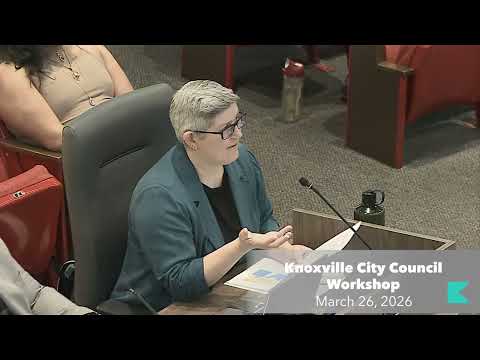
Council workshop reviews homelessness trends and warming-center safety protocols
Summary
City staff presented rising local homelessness counts, how the Office of Housing Stability (OHS) coordinates services through HMIS and coordinated entry, warming-center safety procedures and results from rapid rehousing and permanent supportive housing programs.
The City Council workshop heard a detailed briefing on homelessness response in Knoxville and new safety protocols for warming centers.
Erin Reed, executive director of the Office of Housing Stability, told the council the office's vision is "a Knox community where homelessness is rare, brief, and nonrecurring." She said the city's point-in-time (PIT) counts and HMIS data show demand for services grew from just under 1,000 people in 2018 to more than 1,800 in 2025 and cautioned that PIT counts are an undercount of the unsheltered population.
Reed described the system's range of interventions, including case management, street outreach, rapid rehousing, transitional housing, permanent supportive housing (PSH), shelters and day centers. She cited recent program outcomes: HUD-funded rapid rehousing served 625 people in the last year with 84% of those clients achieving permanent housing; transitional-housing programs served roughly 52 people with an 81% exit-to-permanent-housing rate. Reed said PSH is especially effective for chronically homeless individuals and reported that 95% of clients who enter PSH remain stably housed in the long term.
Cheryl Ball, the city's chief policy officer, outlined a new facility-safety protocol the city instituted for warming centers after the last winter season. Ball said participating sites are inspected by the fire department and reviewed by a fire suppression and life-safety engineer, who helps determine appropriate floor plans, maximum occupancy and staffing to ensure safe overnight sheltering at facilities not originally designed for habitation. "A lot of the facilities that we're using for warming centers were built for other purposes," Ball told council, explaining the purpose of the new inspections.
Panelists described the city's tiered weather response: warming centers and day-space expansions operate under "white flag" surge conditions that kick in at 32' for some providers (with traditional warming centers also used at lower thresholds). Reed said the goal of the warming-center program is that "no one seeking shelter is turned away," and that during the last winter no one was denied shelter under the program, though some people remained outdoors.
Reed also explained operational barriers and outreach: churches have been primary partners for warming centers because existing ministry insurance often covers the activity; nonreligious facilities sometimes face higher insurance costs that can deter participation. The city covers the cost of the engineer review for willing sites, and Reed said the homeless coalition and faith leaders are actively recruiting additional sites.
On funding and outputs, Reed said five federal grant programs plus local contributions bring more than $9.7 million into local homeless services and that, since 2020, local providers and programs have helped 6,357 people find housing. Reed said the office will publish an annual report in the fall and that staff will continue to analyze lessons from the most recent season to improve operations.
The workshop closed with council members asking for follow-up materials, including a geographic map of warming centers and day-space to compare to the distribution of housing investments; Reed said she could produce such a slide and that conversations with partners are ongoing. The vice mayor adjourned the workshop.