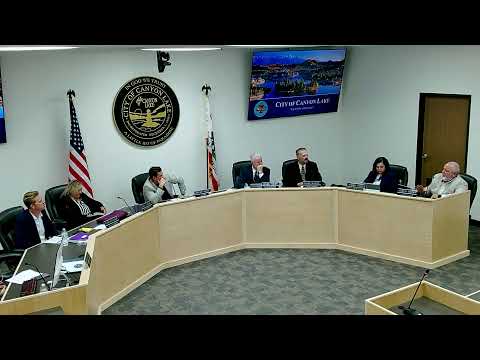
Canyon Lake city manager presents balanced FY 2026–27 budget, council votes to move it forward
Loading...
Summary
City Manager Aaron Brown and finance staff presented a proposed balanced FY 2026–27 budget that centers public safety spending on newly created municipal police and fire services, uses a restricted reserve for one-time equipment, and projects modest revenue growth; council voted to advance the proposal for adoption next month.
City Manager Aaron Brown presented the proposed FY 2026–27 budget to the Canyon Lake City Council, saying the draft is balanced largely because the city established municipal police and fire services and achieved operational savings as a result.
Brown said the proposed general fund revenues and expenditures were closely aligned and highlighted a projected property-tax increase and available grants, including annual CalCOPS law enforcement grant revenue. He noted the draft uses a restricted reserve to purchase a new fire truck (about $130,000) and described a net surplus of roughly $20,000 after that one-time draw.
Why it matters: Brown told the council that creating local police and fire services changed the city’s cost structure and allowed more predictable local coverage and improved responsiveness. “We could be seeing as much as $1,797,000 difference if Canyon Lake did not elect to have a municipal fire and municipal police department,” he said, describing the budget effect of the council’s earlier public-safety decisions.
The draft budget allocates the largest portion of general-fund spending to public safety. Brown and finance staff walked the council through revenue categories — property tax, sales tax, utility users tax, franchise fees and other revenues — and described special-revenue restrictions (gas tax and Measure A for streets and AQMD funds for vehicle-related projects).
Council members questioned staff on program-level details, reserve policy and the city’s event spending. In response to a public comment that asked for an itemized history of event costs, Brown said the city’s current practice budgets total event expenditure and lists sponsorships as offsetting revenue, which can make year-over-year comparisons appear larger if sponsorships increase.
Staff recommended creating a hybrid maintenance/inspection position, shifting some code-enforcement duties to community service officers to enable seven-day coverage, and continuing investments in IT, human resources and building/facilities maintenance.
Public comment: Resident Renee Griffiths asked the council for transparency on event spending and questioned whether expanded event budgets had constrained the city’s ability to raise firefighter pay. Brown and staff said they would provide additional breakdowns and reminded the council the budget as presented reflects direction received in prior council briefings.
Council action: After discussion and staff clarifications, the council voted to move the proposed budget forward and asked staff to return with an expedited presentation at the next meeting and any requested clarifications prior to formal adoption in May.
Next step: Staff will revise line-item clarifications where requested and return the budget for final adoption at the next scheduled council meeting.