Appellate counsel asks court to clarify that no-contact orders need not bar Zoom consultations with counsel
Loading...
Summary
At oral argument, the appellants lawyer asked an appellate panel to rule that domestic violence protection orders do not automatically prevent a parent from appearing by Zoom—muted and solely to consult counsel—when dependency or placement decisions affecting parental rights are at issue; the mothers counsel said the dependency has been dismissed and the Department said reversal may not be warranted.
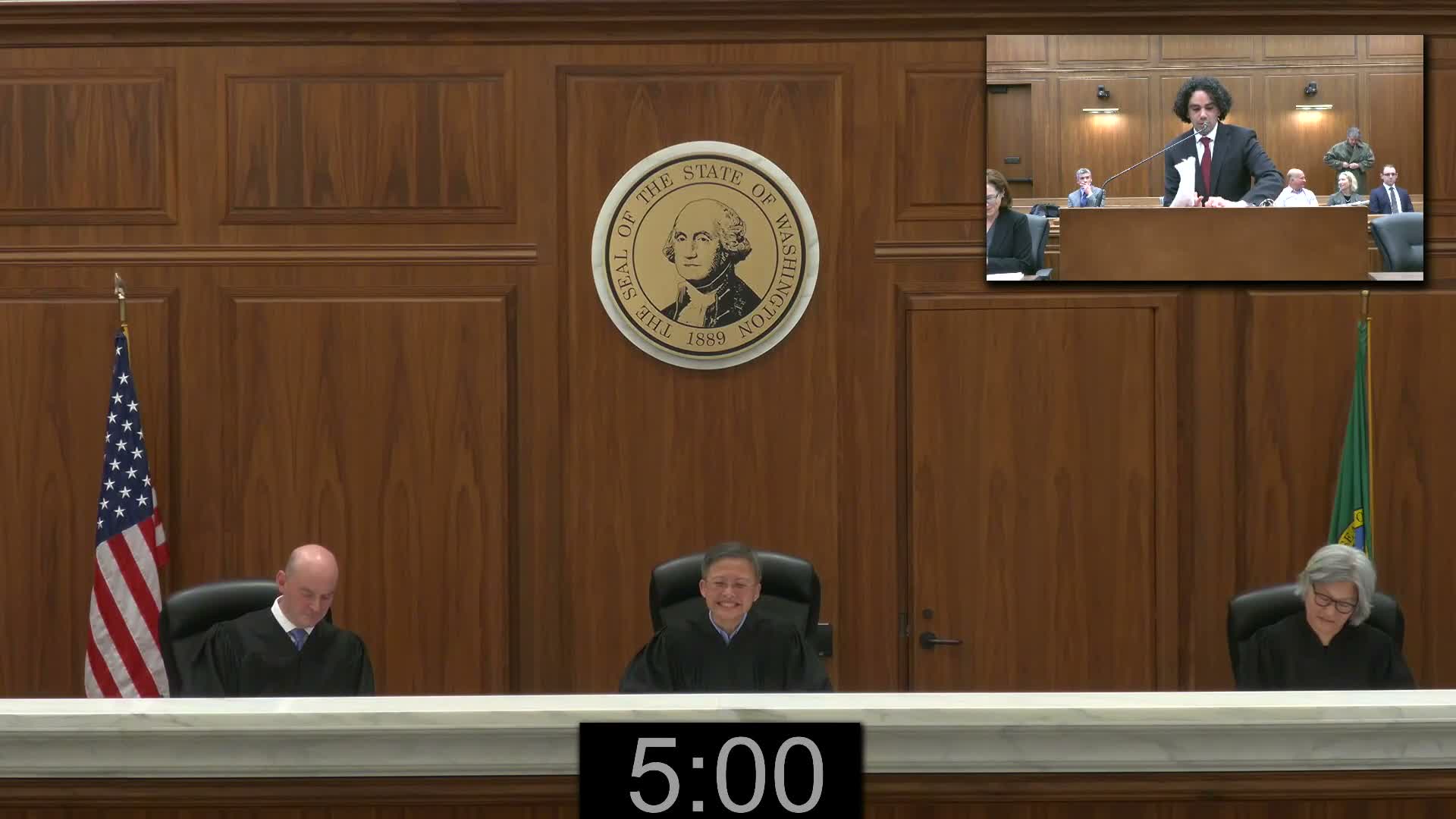
Steve Goliath, an attorney with the Washington Appellate Project representing the appellant, told a three-judge appellate panel that the court should make clear that a domestic violence protection order (DVPO) does not bar a parent from appearing by Zoom solely to consult with counsel in dependency or shelter-care hearings where parental rights or childrens welfare are at stake.
Goliath argued that the trial courts ruling effectively barred his client from any communication in proceedings that directly affect parental rights and asked the court to either remand with instructions to accommodate Zoom consultation or to issue a clarifying opinion. "Let him be on Zoom so he can talk to his lawyer," Goliath said, urging the panel to vindicate what he described as the "bare minimum" of due process when parental rights are implicated.
Jennifer Dobson, counsel for the mother, told the panel the dependency has been dismissed as to both parents and described the dismissal as making the appeal potentially moot. "The dependency has been dismissed," Dobson said. She offered to supplement the record with documentation of that dismissal if the court requested it.
A member of the panel repeatedly questioned whether the DVPO's language, as written, expressly prohibited a muted Zoom appearance for the limited purpose of attorney consultation. Panelists also pressed counsel to identify where the trial court had made findings that a Zoom appearance would retraumatize the protected party; Dobson said the petition and related protection-order materials, presented below, showed the mothers continuing fear and that the parties had agreed to a bifurcated process because of domestic-violence history.
Josh Cho, representing the Department of Children, Youth and Families, told the court the department no longer had a legal interest in the appeal but suggested the record may not satisfy the "effects" prong needed to show reversible error under the applicable tests. Cho also observed that, according to the record, the children were later returned to the appellant.
The panel and counsel discussed applicable standards. Several panelists proposed applying the Mathews v. Eldridge balancing test to weigh the private interests at stake, the state's interest in accurate proceedings, and the marginal value of allowing Zoom consultation. Counsel for the appellant relied on precedent cited in the transcript as "MB," arguing it requires protection of basic due-process rights where parental rights are at stake; the transcript does not provide a full citation for "MB."
The court allowed counsel time to supplement the record with the dismissal documentation and stated it would accept briefing or additions as necessary. Counsel for the appellant told the panel that even if the case were dismissed, an appellate opinion would serve the public interest by clarifying whether no-contact orders are being misread to exclude parents from procedural participation that does not involve in-person contact.
The argument closed with a request from the appellants counsel that the court provide guidance to avoid future exclusions of parents from hearings on the basis of overbroad readings of DVPOs. The panel did not announce a decision at the hearing; it invited supplementation of the record and further briefing.