Get Full Government Meeting Transcripts, Videos, & Alerts Forever!
Get email alerts on the Workforce Development topic
No spam. Unsubscribe anytime.
Norwalk health officials outline workforce training plan and mark decade of volunteer emergency response support
Summary
At its March 24 meeting, Norwalk’s director of health and a department presenter described a workforce development plan tied to accreditation standards and announced an all‑staff training day; staff also summarized a decade of Emergency Response Team volunteer work and a member survey that will guide program improvements.
Diana D'Amore, director of health for the city of Norwalk, and a department presenter summarized the health department’s workforce development strategy and an update on the Emergency Response Team at the Board of Health meeting on March 24, 2026.
The department framed workforce development around staff satisfaction and core public‑health competencies, saying training will be guided by needs assessments and national tools such as the Public Health Accreditation Board standards and the De Beaumont Foundation’s workforce survey. "Our first goal is actually to have a happy, diverse, and skilled workforce," the presenter said, describing a curriculum that maps training topics to accreditation measures and designates target audiences for each session.
Why it matters: the department said having a structured, recurring training program will help sustain clinical and field staff, reduce burnout and improve program quality. Staff listed priorities for 2026 that include building‑safety drills, a refresher on the incident command system (ICS), climate‑and‑health training, service‑animal guidance for city buildings, and additional leadership training such as change management and finance basics.
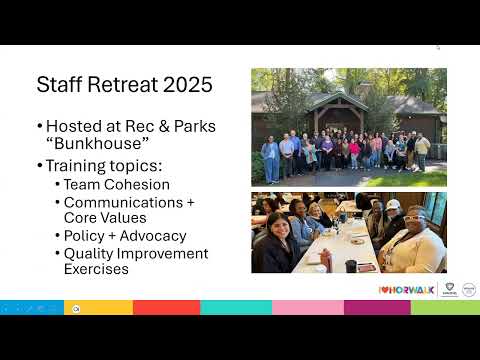
The presenter announced an all‑staff training day scheduled for the day after the meeting to deliver mandatory modules and time for independent coursework. She said the department tracks continuing education units, certifications and licenses, and uses staff feedback and QI exercises to shape the curriculum. "We try to map that out according to the public health accreditation board standards and measures," she added.
The department also reviewed its Emergency Response Team (EART), a community‑based volunteer program that supports vaccine clinics, food distributions, mass‑care operations and other public‑health events. Staff said EART — which began in 2016 — trains one to two cohorts a year and supplies roles ranging from vaccinators to registration, traffic/parking, and logistics for points of dispensing (POD) operations. The presenter listed prior training topics such as CPR, shelter operations, Narcan use, "stop the bleed" and volunteer reception centers.
Board members praised the EART and described positive volunteer experiences. The presenter said staff surveyed current volunteers to learn why members join, what they value, and which activities interest them; the volunteer coordinator will share results with EART members and the department will analyze the data to identify QI opportunities and adapt onboarding, training and communications.
D'Amore closed the item by thanking volunteers and staff. The department said next steps include completing data collection and analysis of the volunteer survey, identifying possible QI initiatives, and delivering responsive programming and communications shaped by volunteer feedback.