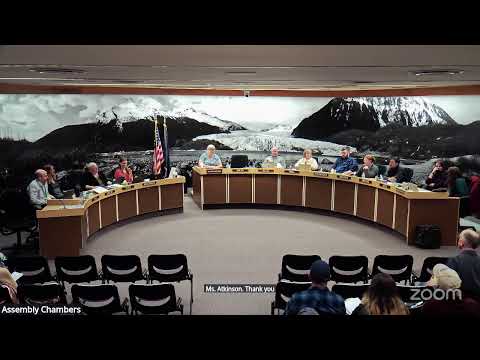
Assembly warned of $14 million sales-tax shortfall as members outline two-year budget plan
Loading...
Summary
Juneau officials told residents the FY27 budget faces a larger-than-expected gap — driven by a mill-rate cap and sales-tax exemptions — and laid out a two-year plan using targeted service reductions, fee increases and a temporary draw on fund balance to smooth the transition.
Mayor called the April 15 special assembly meeting to order and turned the session into a public listening forum on the manager’s proposed FY27 budget. Director Flick and Manager Kester told the assembly and residents the city faces steep revenue losses tied to recent ballot measures and soft sales in the economy.
Director Flick summarized the process and the magnitude of the gap: a mill-rate cap enacted by ballot reduced the tax base (moving the mill rate below prior levels) and sales-tax exemptions for essential foods and certain residential utilities took effect immediately after certification. Those changes, combined with softer sales generally, produced an updated estimate of roughly $14 million in reduced sales-tax revenue heading into FY27.
Flick said the updated $14 million reduction is larger than earlier estimates and increases the difficulty of balancing operations for the general fund, which covers day-to-day services such as payroll, streets, parks and building permits. She noted the city’s operating revenue mix is heavily concentrated in property tax (about 48%) and sales tax (about 27%).
Manager Kester described the assembly’s preferred two-year approach to avoid abrupt cuts. The proposal uses limited fund balance as a bridge (Kester said the proposed budget draws about $7.7 million for recurring expenses and $2.6 million in one-time spending), tightens spending assumptions and reduces budget authority for vacant positions so departments may need assembly approval to fill roles. Kester said targeted increases in user fees (Parks & Rec fee changes projected to raise roughly $350,000) and newly adopted cruise-ship dockage/visitor fees (just under $2 million) are part of the package.
Both officials repeatedly framed the fund-balance draw as a temporary measure and warned the assembly faces trade-offs: preserving core services, paying for capital maintenance and responding to near-term flood preparedness needs. They also noted a recent assembly direction to repay a loan related to gondola financing, which could further constrain the unrestricted cushion the city can use.
On legal and practical constraints, staff explained marine passenger fees are governed by a negotiated settlement and federal law (the so-called tonnage clause), limiting the city’s ability to reallocate those fees to broad road maintenance or unrelated general-fund purposes. Flick said the city is aggressively pursuing state and federal grants (including FEMA/BRIC and Army Corps partnerships) for flood mitigation but still expects local maintenance and cost-share obligations.
The assembly emphasized community engagement: weekly finance committee meetings, public workshops and two upcoming public hearings before final budget votes. Mayor and Chair Wall asked residents to continue offering concrete budget ideas while stressing many revenue options would require ballot action or broader community support.
The assembly did not take formal action at the listening session; members said they will continue the deliberative process at future meetings and aim to produce options that balance long-term sustainability with community priorities.