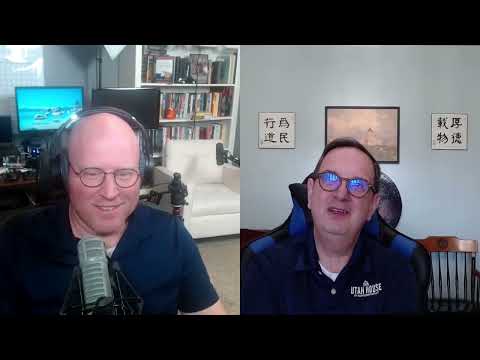
Incumbent Norm Thurston details priorities on water, energy, privacy and local control in Utah County Republican Party podcast
Loading...
Summary
In a Utah County Republican Party podcast, incumbent Norm Thurston, candidate for House District 62, described priorities including lowering health‑care costs, reforming occupational licensing, conserving water through metering and modern agriculture, expanding nuclear energy options, guarding public privacy, and strengthening local control against state overreach.
Norm Thurston, the incumbent seeking re‑election in House District 62, told the Utah County Republican Party podcast that his top priorities include lowering health‑care costs, reforming occupational licensing and keeping government focused on essential services.
"The proper role of government is primarily to protect our citizens from force, fraud, and theft," Thurston said, framing infrastructure intervention as appropriate when markets fail and emphasizing restraint where private solutions exist.
Thurston described health‑care and licensing as connected problems. "Health care worker shortages, that drives up costs," he said, arguing for pathways that let trained people perform jobs without excessive regulatory barriers.
On water and data centers, Thurston urged conservation and technology. He noted that some modern data centers use closed‑loop coolants rather than large water withdrawals and cited Spanish Fork’s attempt to measure secondary (outdoor) water use, telling listeners that a fixed $15 monthly fee for the secondary system led to overuse and that metering changed behavior: "They were paying $15 a month for that secondary water system," he said, and visibility into usage reduced consumption.
Energy reliability and cost were central to Thurston’s economic argument. He advocated a regulatory environment hospitable to nuclear power — including small modular reactors — saying, "Nuclear is clean. It's efficient. It's reliable," and arguing that a stable base load will help keep Utah's power competitive amid a regional grid.
On privacy and surveillance, Thurston opposed broad automated monitoring by government agencies while allowing targeted uses for evidence. "We have a right to not be surveilled when we're not accused of something," he said, adding that intersection and traffic cameras can serve a public purpose when used for accident reconstruction or evidence but warning against compilation of minute‑by‑minute personal location data.
Thurston also promoted a private, state‑endorsed digital identity model that places control with individuals. "Once you have it, it's yours forever," he said of a certified digital identity, likening it to a wallet of credentials that users control and choose which provider to trust.
On internal party rules and ballot access, Thurston criticized the signature path created in SB54 as a poor measure of support: "Gathering signatures is just dumb," he said, describing paid gatherers and court limits that undercut its usefulness. He said he would prefer eliminating the signature route and raising the convention threshold to about 67–70 percent to reduce unpredictable delegate swings.
Regarding Prop 4 and redistricting, Thurston said he favors competitive elections in principle but argued that Prop 4’s language about keeping communities of interest together has, as implemented, encouraged packing voters into one district rather than producing competitiveness. He advocated modifying the law to allow more competitive maps but acknowledged legal uncertainty from court rulings.
Thurston described his standard for voting in the legislature as conservative on last‑minute, un‑heard bills: he prefers public committee hearings and transparency, and said he has worked to track fiscal‑note bills referred to the rules committee so legislators and the public can review them rather than see them appear unexpectedly at the end of session.
Wood, the podcast host and vice chair of the Utah County Republican Party, asked Thurston to explain his background and approach. Thurston said he has served in precinct and delegate roles for more than two decades and emphasized constituent contact, saying elected officials should view their role as servants who must continuously answer to voters and delegates.
Thurston provided contact details for follow‑up: NormThurston.com, normthurston62@gmail.com and (801) 477‑5348. The episode is scheduled to be posted before the county convention so delegates and voters can review his answers ahead of selection.
Thurston’s positions reported here are based on his responses during the podcast interview and are presented without editorialization.