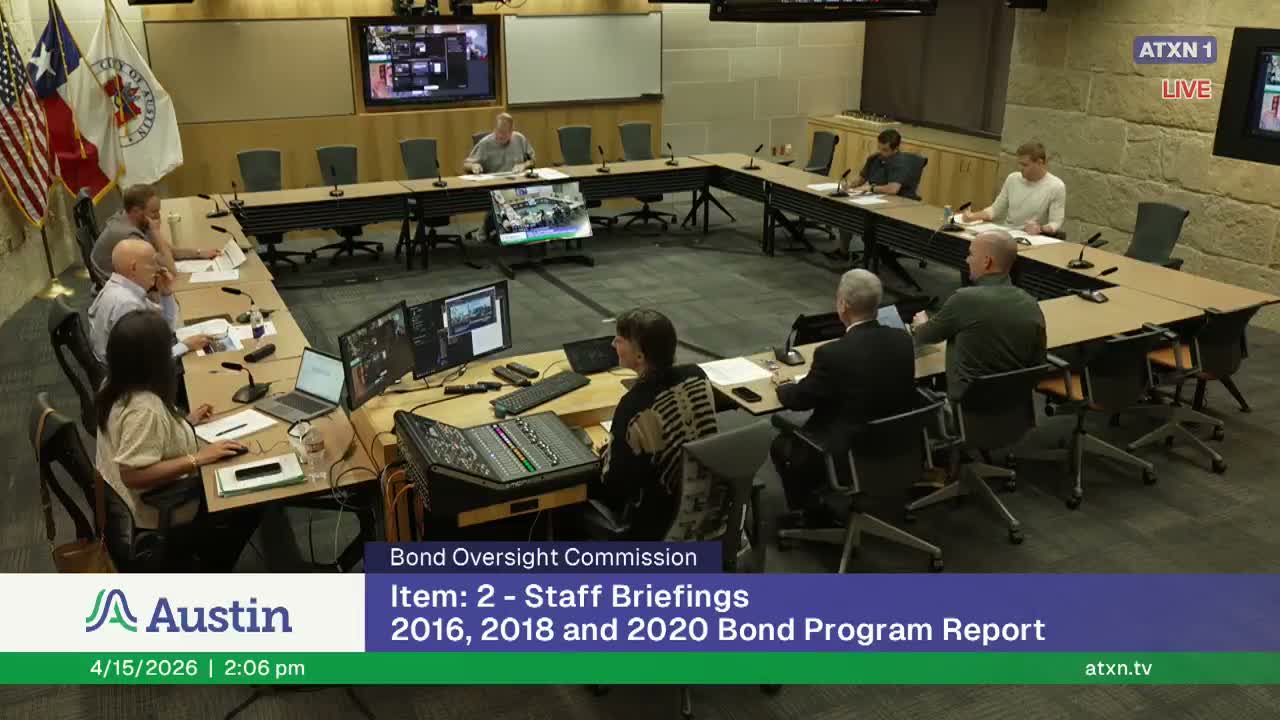
City staff: a few major projects hold most unspent bond dollars as commission eyes reporting changes
Loading...
Summary
Capital Delivery Services deputy director Eric Bailey told the Bond Oversight Commission that a small number of projects account for the bulk of unspent non-housing bond balances, and commissioners pushed staff and Financial Services for clearer, disaggregated quarterly reporting to identify recurring barriers to spending.
Eric Bailey, deputy director of Capital Delivery Services, told the Bond Oversight Commission on Jan. 8 that "relatively few number of projects" are holding most of the unspent balance in the city's recent non-housing bond programs and presented data visualizations to show which projects are lagging.
"Since the creation of CDS in 2023 to 01/08/2026, project spend has more than doubled from $573,000,000 to $1,200,000,000," Bailey said, adding that the authorized-but-unobligated balance fell from $1,400,000,000 to $599,000,000 as more work moved into contracts and construction. He said those numbers indicate projects are progressing from design into construction and obligation.
Bailey walked commissioners through the definitions used in the presentation: "expenses" for dollars paid out for design, construction and acquisitions; "obligation" for dollars under contract; and "balance" for identified future spending. He said the presentation focused on the 2016, 2018 and 2020 bond programs because the 2022 bond was housing-only and is managed differently.
On the 2016 mobility bond (a $720,000,000 program), Bailey said the corridor component ($482,000,000) contains several large corridor projects that together hold most of the remaining balance. He identified the South Lamar Boulevard corridor (Barton Springs to U.S. 290) as one of the most complicated projects because it requires coordination with Austin Energy, Austin Water and Watershed Protection; Bailey said it is at 100% design and scheduled to be advertised for bid in mid-2026. He also highlighted North Lamar (Runbrook to Palmer), currently at roughly 60% design and including a new bridge over Walnut Creek.
For the 2018 bond, Bailey said housing, health and human services, and public safety propositions are 100% contracted; libraries, museums and cultural centers lag behind, with the Mexicarte Museum, Jordy Art Center and the Asian American Resource Center accounting for the majority of the outstanding balance. He said the Doherty Arts Center has been put on hold while staff look for additional funding.
The 2020 transportation bond ($460,000,000) covers sidewalks, urban trails, bikeways, Vision Zero, Safe Routes to School and major capital improvements; Bailey cited the Longhorn Dam multimodal improvements (the Wishbone Bridge) as a recent delivery success.
Commissioners pressed staff on causes of delays. Bailey said long design and permitting timelines and large stand-alone projects can create a "long tail" in spending: heavy construction-phase spending often occurs late in a project's life cycle, leaving programs with unspent balances even as many projects finish. He said the city is transitioning to using a 90% spend milestone — projected around 2028 for the combined non-housing portfolio — as a planning signal for the next bond election.
Bailey and commissioners discussed coordination across departments. When asked whether duplicate or overlapping designs occur, Bailey said project delivery is coordinated across sponsor and managing departments: sponsor departments hold funds and managing departments deliver projects. He said larger projects often require formal design and contracting (where CDS frequently manages delivery), while local mobility projects (sidewalks, safe routes) are commonly delivered through field engineering and indefinite-delivery, indefinite-quantity (IDIQ) contracts and may be self-managed by departments.
The presentation identified a small number of "purple" projects with large unspent balances that the team will prioritize to "get unstuck" — resolving permitting, design or contracting hurdles so work can move into construction.
The commission agreed the briefing provided useful context; members asked staff to follow up with more disaggregated data on program-level balances and project status and to coordinate further with transportation and utility departments on timing for projects such as South Lamar.
The commission closed the item after questions and thanked Bailey for the briefing. The next substantive steps noted were staff follow-ups on project-level spending plans and coordination with Financial Services on reporting.