Get Full Government Meeting Transcripts, Videos, & Alerts Forever!
Get email alerts on the Body Worn Camera Fees topic
No spam. Unsubscribe anytime.
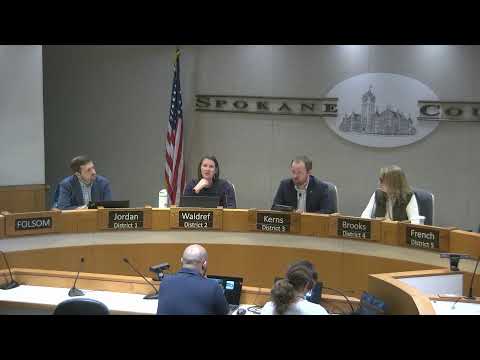
Spokane County commissioners approve fee to cover redaction work on body‑worn camera videos
Summary
The Spokane County Board approved a fee schedule to recoup staff labor for statutorily required redactions of sheriff’s office body‑worn camera footage after a public hearing in which residents and accountability advocates urged the board to fund redaction through taxes instead of fees.
Spokane County commissioners voted unanimously to approve a fee schedule that will allow the county to charge third parties for staff time spent applying statutorily required redactions to sheriff’s office body‑worn camera recordings.
County staff told the board the fee is limited to the labor involved in applying redactions mandated by state law and does not cover staff time spent reviewing footage when no redactions are required. Staff cited the Public Records Act (RCW 42.56.240(14)) as authorizing recovery of those costs and said the county used a time study to calculate fees.
The county’s public records officer said stopwatch trials indicated it takes about six minutes of staff time to redact one minute of raw footage for targeted audio and video redactions and that the study calculated a labor cost of about $0.78 per minute of redaction. Using that method, staff gave an example in the hearing that redacting a 10‑minute clip could require roughly 60 minutes of staff time (about $46.80 in labor at the stated rate).
Two residents and accountability advocates spoke against the proposal during a public hearing. Bethany Combs, who said she has worked in and around the legal system in Spokane County, argued that redaction should be paid from tax revenue so privacy protections are not conditioned on an individual’s ability to pay: “I want my taxes to help protect someone’s privacy,” she said, warning that fees could force low‑income requesters to choose between basic needs and securing redactions. Jim Lede, representing the Washington Coalition for Police Accountability and Spokane Community Against Racism, said the proposal risks creating a barrier to transparency and questioned whether similar footage access is treated consistently across media and county agreements.
County staff responded that in‑person review of body‑worn camera footage at county facilities would not trigger fees and that the fee would apply only to third‑party requests where statutory redactions must be applied. Staff also noted that many Washington jurisdictions have similar fee practices and that the proposed revenue would go to the county’s general fund and be considered as part of upcoming budget processes, including the 2027 budget.
After discussion, a commissioner moved to approve public hearing item 4A as presented by staff; another commissioner seconded, and the motion passed unanimously.
The board also received a letter-request about renaming an I‑90 overpass at 4 Lakes in memory of a Spokane County sergeant, Ken Salas, and staff said a letter of support could be placed on the next consent agenda for formal action. The meeting was then adjourned.