Lifetime Citizen Portal Access — AI Briefings, Alerts & Unlimited Follows
Consultants tell Spokane Valley council that state law reshapes housing and climate work; council presses for clarity
Loading...
Summary
Consultants explained new state mandates for housing capacity disaggregation, a greenhouse‑gas inventory that pins transportation as the largest source of emissions, and a new climate element that flags heat, wildfire and flood risks; council pushed for clearer language and feasibility checks.
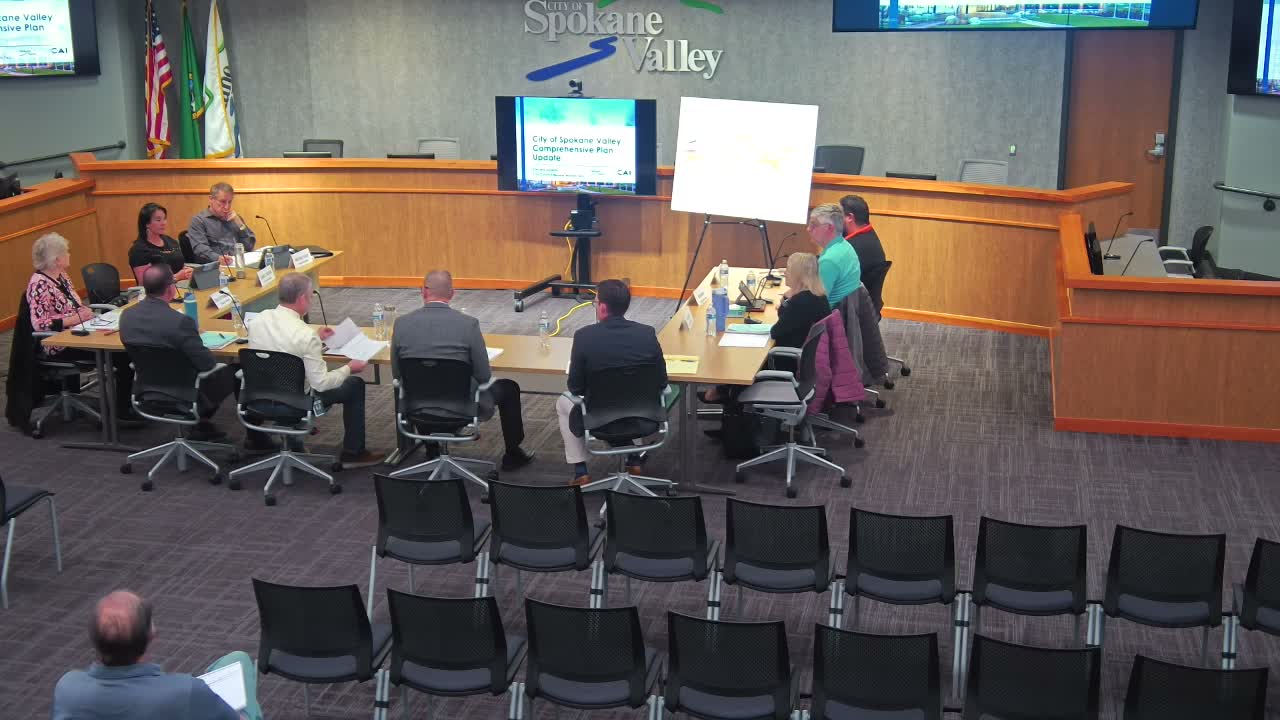
Consultants briefed the Spokane Valley City Council on April 14 about several elements of the city’s comprehensive plan update, focusing on housing, utilities and a new climate and resiliency chapter required by state law.
On housing, Elliot (consultant) told the council that a Growth Management Hearings Board decision requires jurisdictions to disaggregate housing capacity by income bands rather than rely on an aggregate unit count to meet House Bill 1220 obligations. Elliot told the council he would review a recent letter the council received that suggested an alternate methodology and follow up if there are inconsistencies.
Elliot summarized statutory changes the city must address, noting House Bills 1110 (middle housing) and 1337 (ADU legislation) require cities to allow middle housing in single‑family zones and to allow accessory dwelling units by right. He said the city must perform a land‑capacity analysis and identify “adequate provisions” — policy tools such as multifamily tax exemptions, incentive zoning, land dedication, permit waivers and partnerships — that could help fill gaps in affordable housing delivery.
On climate and resiliency, Nicole Gutierrez of Cascadia Consulting Group outlined the element’s two subcomponents: an emissions‑reduction subelement and a resilience subelement. Nicole said the city’s 2025 greenhouse‑gas inventory estimated roughly 766,127 metric tons of CO2e and attributed about 63% of emissions to on‑road transportation and about 24% to building fuel use. She said the resilience work identified priority hazards including extreme heat, declining snowpack, elevated wildfire and increased flood risk.
Councilmembers pushed back on some language and time horizons. Councilmember Merkel asked consultants to clarify statements in the racially disparate impacts attachment that suggest current policies produce disparate outcomes; consultants said they would edit the language and point to specific policies or remove wording that could be misread. Several members questioned the emphasis on end‑of‑century (2100) projections, urging that the city also present nearer‑term (2050) scenarios that better align with a 20‑year plan horizon.
On utilities, SCJ Alliance’s Bill Grimes said the utilities element focuses on private providers (energy, natural gas and telecommunications) and the city’s need to coordinate with proprietary data sources; councilmembers raised concerns about predatory solar contractors, hydropower’s role in the regional grid and the inclusion of battery energy storage systems in policies — items consultants agreed to review.
Consultants told the council they will: review and edit the RDIA language for clarity and citations, conduct further feasibility analysis on proposed adequate provisions, incorporate council feedback into the draft elements, and return with more detailed memoranda and a schedule to meet the Department of Commerce grant deadlines.
Councilmembers and staff agreed to continue the public process, including an upcoming developer workshop and additional packet material tying land‑use scenarios to housing unit allocations and draft development regulations.