Get Full Government Meeting Transcripts, Videos, & Alerts Forever!
Get email alerts on the Transportation Funding topic
No spam. Unsubscribe anytime.
Snohomish County warns of $6 million–$9 million roads shortfall; public works director backs $20 car‑tab fee
Summary
Public Works Director Kelly Snyder told the committee the county faces a $6–$9 million near‑term shortfall for roads maintenance and preservation, outlined the risk of deferring 14 projects and 34 FTE equivalents, and recommended a $20 vehicle license fee via a Transportation Benefit District as the most effective immediate revenue option.
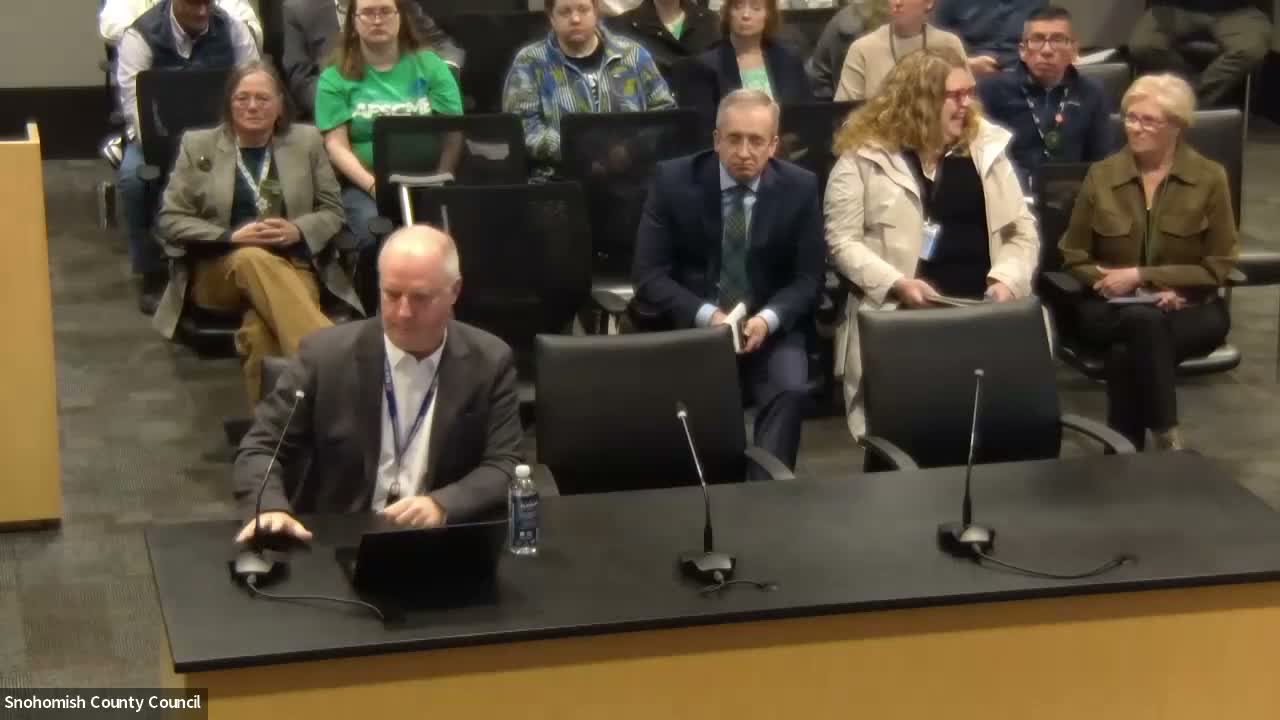
Kelly Snyder, Snohomish County public works director, told the Public Infrastructure & Conservation Committee on March 17 that the county faces an immediate operations and preservation shortfall of roughly $6 million to $9 million and that without new revenue the department will likely have to cut projects and staff. "Where do we make up that shortfall of 6 to $9,000,000?" Snyder asked; she warned the county is considering cutting 14 capital projects, a measure that would risk turning back about $66,500,000 in grant‑funded work and representing an FTE equivalent loss of about 34 positions.
Snyder detailed the county's road responsibilities — about 1,600 lane miles, 210 bridges (13 under a weight restriction) and more than 200 intersections supported across jurisdictions — and said existing road levy revenue and declining gas tax receipts cannot cover rising construction inflation she cited as about 39 percent. She explained that many grants require local matching dollars and that reducing levy capacity constrains the county’s ability to leverage outside funding.
As an immediate revenue option, Snyder said a $20 vehicle license fee collected by a Transportation Benefit District (TBD) would generate about $6,000,000 annually, preserving staff and projects identified for reduction. She contrasted that with a proposed 0.1 percent sales tax limited to unincorporated areas, which she said would raise about $4.5 million. "The $20 vehicle license fee that's part of the transportation benefit district will preserve the things, the $66,500,000, the staff, as well as the projects," she told the committee.
Snyder urged urgency: the Department of Licensing (DOL) requires roughly six months to implement a TBD once the county acts, and she said the county needs a final decision by June 1 to avoid layoffs or project shutdowns. She also outlined longer‑term options such as a roads levy lid lift (estimated 9–12 months to prepare and run) as part of a multi‑tool approach to fiscal sustainability.
Committee members pressed for clarity. Committee Member Mead asked why the executive branch had not presented the "break the glass" urgency sooner; Snyder said leadership and departments had managed vacancies and deferred work over prior years and argued the crisis has escalated rapidly, citing a multiyear trend of vacancy management and inflationary pressures. Committee Member Neri asked about the interaction between levy lid lift proceeds and operations vs. capital; Snyder confirmed levy lid lift dollars could be used for both.
The chair said the committee will carry related ordinances to the April 21 meeting for further committee discussion and for a public hearing to be set after that, with the aim of preserving the June 1 timeline for any implementation steps.