Get Full Government Meeting Transcripts, Videos, & Alerts Forever!
Get email alerts on the Afr Reporting topic
No spam. Unsubscribe anytime.
Department of Management webinar outlines AFR deadlines, GAAP vs. cash rules and new debt-reporting page
Summary
Carrie Johnson of the Iowa Department of Management reviewed county Annual Financial Report requirements for fiscal 2025, stressing the Dec. 1 filing/posting deadline, how cash and GAAP reports differ, fund-balance categories under GASB 54, and a new debt-detail page added by House File 718 that DOM will compile for the legislature by Jan. 15.
Carrie Johnson of the Iowa Department of Management on the webinar explained what counties must file for fiscal 2025 Annual Financial Reports and how to complete the online AFR system.
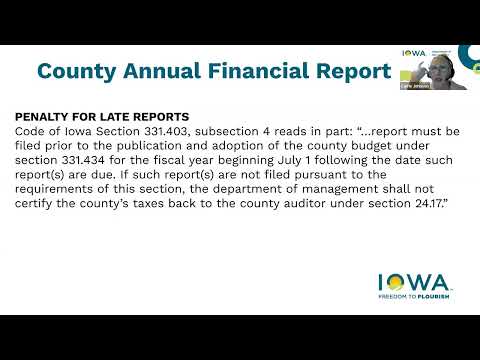
Johnson told attendees that most counties must submit their AFRs by December 1 and that the publishable summary page must be in the newspaper (for cash-reporting counties) or posted online (for GAAP counties). "December 1 is the deadline," Johnson said, adding that "there is no extension provision in statute." She said Department of Management staff must compile debt information from submitted AFRs to send to the General Assembly by Jan. 15, and urged counties to file promptly to avoid being listed as having no data.
Johnson walked through the key structural difference between cash-basis and GAAP AFRs. Cash counties complete a cash report and publish a one-page summary; GAAP counties submit a GAAP report that includes a balance sheet and additional debt-detail pages. She noted the AFR software generates many calculated fields (white cells) while counties must enter other values (blue cells), including the budget-totals column on the publishable summary used to compare budgeted amounts and actual results.
On revenues Johnson highlighted the property-tax lines: taxes levied, delinquent taxes, credits to taxpayers and state replacements. She cautioned that those figures may not exactly match what a county certified in its budget because of rounding or post-certification valuation changes, and explained how July/August collections may be accrued to the prior fiscal year.
For expenditures she explained that AFRs report spending by service-area program pages that roll up to a service-area 0 summary and to the publishable page. Johnson also reviewed transfers between budgetary funds and when a movement should be recorded as a transfer versus an expenditure.
Johnson reviewed fund-balance reporting under GASB 54 and how the AFR calculates ending fund balance: nonspendable, restricted, committed, assigned and unassigned components are derived from reported resource and requirement fields. She said differences between GAAP balance-sheet totals and gap-summary fund balances commonly stem from rounding or omitted designations and flagged those as frequent causes of balance-sheet errors.
A major change for fiscal 2025 is the debt-reporting page added by House File 718. Johnson said the new county-debt detail requires listing outstanding bonds, notes or other obligations with principal outstanding at the beginning of the fiscal year, amount of issue, purpose, method of approval (voted/nonvoted/essential), rate range and whether the debt is tied to other obligations. The fields include a short (150-character) projects-funded description. Johnson gave an example: a 2014 GO secondary-road bond series with its resolution number, rate range and outstanding principal.
She also explained online-system procedures: role-based access (county auditor or assigned staff), how to edit and save reports, error-checking (red errors block publishing; yellow warnings do not), the publish/post workflow and how to enter a newspaper publication date for the printed summary. Johnson reiterated that AFRs may be amended after posting (for audit corrections) using the application's amendment option, and the amended version becomes the public record once republished.
Johnson said she will send the presentation to ISAC and email county auditors when the recording and materials are posted. She invited follow-up questions, especially about the new debt page.
The webinar did not include votes or formal board actions; it was an instructional presentation with Q&A. The next procedural step for counties is to prepare and submit AFR data through the DOM online system in time for the Dec. 1 posting/publication and for DOM to assemble the debt report for the General Assembly by Jan. 15.