Lifetime Citizen Portal Access — AI Briefings, Alerts & Unlimited Follows
Commissioners authorize August ballot measure to create West Plains Aquifer Protection Area
Loading...
Summary
Spokane County voted April 14 to put a proposed West Plains Aquifer Protection Area on the August 2026 ballot; staff proposed a boundary covering about 18,000 parcels, an annual fee structure (example: $15/year for single-family homes on sewer, $30 if not connected), an estimated $400,000 in annual revenue and a 20‑year term to fund monitoring, planning and conservation.
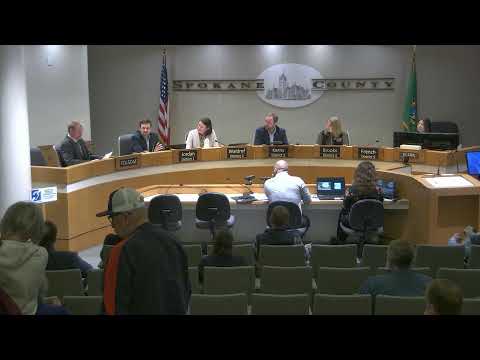
Spokane County commissioners unanimously authorized a ballot measure April 14 to ask voters in the West Plains to approve an Aquifer Protection Area (APA) that would collect annual fees to fund monitoring, planning and water-related projects.
Ben Bradepo, a county water-resources official, outlined a plan that mirrors an existing Spokane Valley–Rathdrum Prairie APA. He said the proposal uses voter-precinct boundaries to define the West Plains APA, excludes federal installations (Fairchild Air Force Base) because fees cannot be applied to a federal property, and currently excludes the Spokane International Airport area due to separate inclusion in the existing APA. Staff estimated the boundary would include roughly 18,000 parcels, many undeveloped and therefore not charged, and projected about $400,000 in annual revenue under an example rate structure.
Fee and use details: The presentation showed an illustrative rate table that charges single-family residences connected to sewer $15 per year and the same residence not connected to sewer $30 per year; duplexes and accessory dwelling units carry additional charges; nonresidential properties would be assessed by meter size. Funds, if approved, would be spent on a broad range of activities allowed by state law (RCW) for aquifer protection including groundwater monitoring (depth and quality), sanitary sewer and stormwater planning, infrastructure projects, education and enforcement. Bradepo said one early priority would likely be establishing improved monitoring to create long-term datasets unique to the West Plains.
Public input and concerns: Several residents urged action to address PFAS contamination and to prioritize monitoring, closing unlined wells and programs to protect drinking water. Others asked for more detail on governance, oversight for unincorporated areas, whether polluters should pay (naming the airport and military base) and how funds would be prioritized. Staff said the ballot language is deliberately broad to reflect allowable uses under state statute and that the county would work collaboratively with participating cities on budgeting and prioritization if the measure passes.
Timing and governance: If voters approve the APA in August, fees would appear on property tax statements starting in 2027. The measure as presented would last 20 years before requiring voter renewal. Staff said funds could be used to leverage state or federal grant matches and could potentially fund targeted rebate or conservation programs in coordination with cities.
What happened: The board voted to place the West Plains APA measure on the August 2026 ballot by unanimous vote. Staff will continue outreach and planning, including working with cities that have already agreed to participate.