Seattle committee calls for outside audit of Vision Zero as SDOT reports 27 fatalities in 2025
Loading...
Summary
Chair Rob Sacca asked the City Auditor to conduct an external performance audit of Seattle's Vision 0 program after recent fatalities; SDOT told the committee the department revised its 2025 fatalities tally to 27 and outlined projects, grants and measures — including $25 million from a federal Safe Streets grant and plans to daylight 200 intersections.
Chair Rob Sacca opened the meeting by announcing he has asked the City Auditor to conduct an outside performance audit of Seattle's Vision 0 program to review data fidelity, regulatory compliance and program effectiveness. "This audit will help us take a hard look at what's working, what's not, and where we need to sharpen our approach to prevent further tragedies on our roads," he said. The chair said the audit is expected to commence in the fall and that findings will be presented to a future committee meeting.
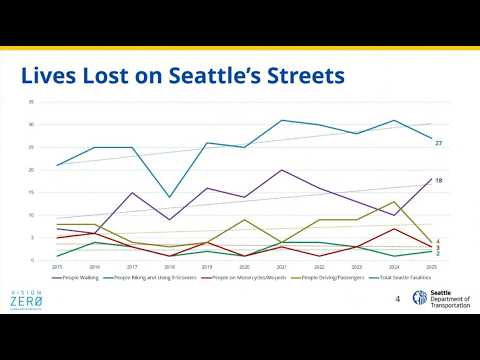
Vindon Imani, who introduced himself as chief transportation safety officer and city traffic engineer for the Seattle Department of Transportation, reviewed the department's Vision 0 metrics and projects. Imani said SDOT revised the 2025 count of lives lost on Seattle streets to 27 after matching police crash reports and state records, including one delayed Rainier Avenue fatality and a death involving an e-scooter that SDOT conservatively included while investigating the cause. "To be conservative, we chose to include in the total number of lives lost," he said.
SDOT told the committee there were 57 serious injuries in 2025 (at least 16 involving e-scooters) and that more than 80% of fatal and serious collisions occur on the city's High Injury Network. Imani identified priority corridors for further action — including Rainier, Aurora, MLK, Lake City Way and 4th Avenue South — and summarized 2025 project completions (high-injury location treatments, pedestrian head-start signals, no-turn-on-red installations). He said SDOT completed corridor and intersection improvements in 2025 and has a pipeline for 2026 that includes arterial traffic calming on dozens of corridors and design work for 18 construction-ready corridors.
The department also highlighted grant funding: SDOT said it received approximately $25,000,000 from the federal Safe Streets and Roads for All program and is investing additional local funds to advance pedestrian and bicycle safety projects that must be completed by 2029. SDOT described a roundabout concept at Rainier Avenue and Cornell Avenue South as an example of corridor-level work to reduce speeds and collision severity.
In a series of questions from council members, SDOT officials discussed enforcement and engineering: automated safety cameras were described as one of many proven countermeasures that can reduce speeds, but SDOT said it does not direct police enforcement and that its primary tools are design and operations. On post-crash response, Imani outlined current practice: notification via SDOT's Transportation Operations Center, follow-up when police traffic collision reports arrive (typically within days to weeks), a site visit to document conditions and immediate maintenance where appropriate, followed by longer-term project prioritization. He said SDOT is developing policy options to enable more rapid "quick-build" responses to fatal crashes while balancing data latency and liability concerns.
Public commenters and advocates urged faster, more aggressive action. Gordon Padelford of Seattle Streets Alliance said political will is the missing ingredient for big changes on high-risk arterials; Carlo Alcantaro (Aurora Reimagine Coalition) asked the committee to adopt a 72-hour rapid-response goal for preventing repeat fatalities. SDOT representatives acknowledged the public urgency and said they are evaluating options to respond more quickly while protecting public safety and managing risk.
Chair Sacca closed by noting the council has appropriated substantial levy dollars for safety and that the audit will help sharpen accountability and program effectiveness. The committee did not vote on policy changes during the meeting; SDOT will return with further detail and the auditor's review is expected to be scheduled in the coming months.