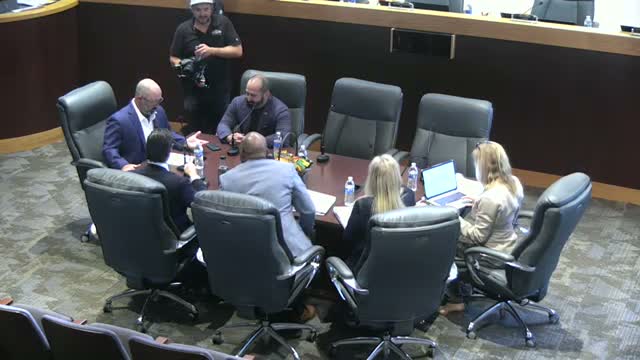
Broward Solid Waste Authority presents master plan, outlines phased funding and drop‑off center plan
Loading...
Summary
At a City of Parkland commission workshop, Broward Solid Waste Authority staff and consultants presented a completed regional master plan and a three‑phase funding proposal that would move from population contributions to a $2.22/ton surcharge in FY2028 and later to a non‑ad valorem assessment; commissioners pressed for clearer cost and enforcement details.
The Broward Solid Waste Authority and its consultant, SCS Engineers, presented a completed regional master plan at the City of Parkland’s April 15 workshop and described a three‑phase finance and implementation plan that the Authority’s executive committee will ask its governing board to adopt.
Daniel Deitsch, an SCS Engineers representative working on the plan, said the master plan has been sent to the Authority’s executive committee and “the master plan is now complete.” He said the executive committee recommended adoption and that the governing board will consider requesting member municipalities’ approval. Deitsch added the related facilities amendment will be transmitted to interlocal agreement (ILA) members; each member will have 120 days to review and decide whether to approve that amendment.
The plan’s funding model has three phases, Deitsch said. Phase 1 preserves a population‑based contribution (an initial $2 million pooled contribution across ILA members). Phase 2, modeled to start in fiscal year 2028, moves to a per‑ton surcharge imposed at receiving facilities; in the Authority’s model that surcharge is $2.22 per ton. “So the surcharge will be … $2.22 per ton,” Deitsch said. Using the plan’s waste‑generation assumption of about 1.3 tons per single‑family household per year, the Authority calculated roughly $2.89 per household in FY2028 — about 24 cents per month. Phase 3 contemplates a future non‑ad valorem assessment billed on the tax roll tied to a demonstrated benefit and to facilities; Deitsch said that assessment was modeled to escalate with CPI and could show higher per‑ton numbers in later years.
Why the multi‑phase approach: Deitsch and Sam May, Executive Director of the Broward SWA, said the Authority wants an enterprise‑style nexus between cost and benefit, to secure predictable long‑term processing and disposal contracts and to fund education, outreach and convenience drop‑off centers. Deitsch said solicitations will be prepared for three categories — yard trash, traditional recyclables, and disposal/processing — and that “flow control” under the ILA would allow the Authority to negotiate binding prices when it holds the processing/disposal contracts.
The presentation included policy details and assumptions: the plan’s fiscal model starts from a countywide estimate of roughly 5 million tons of waste generated annually, backs out about 500,000 tons not subject to assessment and excludes an estimated 10% of the stream that never crosses a scale (leakage). Deitsch also noted current county‑negotiated tipping fees and proposed a capped tipping fee for recyclables near $110 per ton based on market analysis.
Commissioners asked whether households would pay more under the plan, how the Authority would work with existing hauler contracts, and whether the Authority could compel municipalities that do not now provide curbside recycling to change course. One commissioner noted Parkland’s current contract with Waste Management and asked about its expiration; Deitsch confirmed the Authority expects to coordinate with member municipalities and county ordinances for elements that require county enforcement, such as mandatory commercial recycling.
Deitsch said the plan budgets initial education and outreach at roughly $10 per household (spread across tons in the financial model) to support behavior change and to lower contamination rates in recycling streams. He also described planning for eight modest convenience drop‑off centers to serve residents and to accept hard‑to‑recycle materials (batteries, electronics and household hazardous waste); he said the modeling assumed a countywide geographic distribution for those eight sites and that development could be via county land or contracts rather than direct Authority ownership.
Commissioners pressed for additional clarity on costs and trade‑offs. Questions highlighted: how the Authority derived eight sites (geographic distribution vs. utilization data), whether building/operating drop‑off centers would raise costs compared with contracting with existing providers, and whether the plan’s scenarios included externalities such as increased vehicle miles for drop‑off trips. Deitsch said a range of scenarios was analyzed, that the chosen approach leverages existing private and public infrastructure to avoid building large new processing facilities, and that externalities such as carbon impacts were not included in the financial comparisons.
Next steps: Deitsch said the SWA governing board will consider adoption and that the facilities amendment will be transmitted to ILA members for the statutorily required review period. He offered to return for more detailed follow‑ups. The workshop concluded with commissioners thanking the presenters and noting additional questions for the forthcoming governing‑board meeting and amendment review period.
The workshop did not include a formal vote on the master plan or the facilities amendment; those formal actions are scheduled for the Authority governing board and subsequent ILA member consideration.