Get AI Briefings, Transcripts & Alerts on Local & National Government Meetings — Forever.
Arts Commission votes unanimously to deaccession ‘Night Blooming’ at Bellevue Botanical Garden
Summary
The Arts Commission recommended deaccessioning Night Blooming, a spruce public artwork at Bellevue Botanical Garden, after staff reported extensive wood deterioration and safety concerns; the city will remove the work from public view this year and staff will explore reuse options for the engineered foundation.
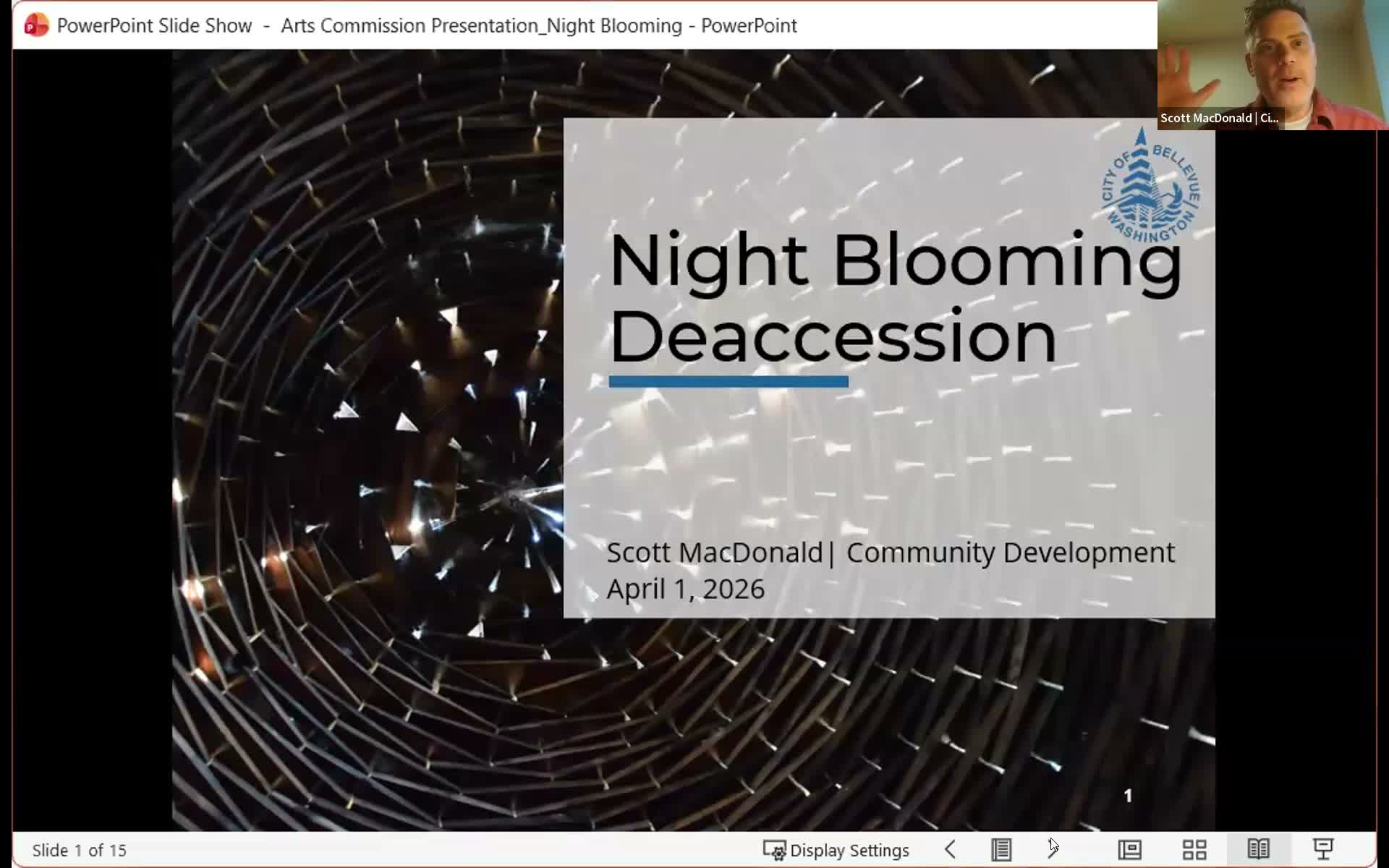
The Bellevue Arts Commission voted unanimously to recommend deaccessioning Night Blooming, a public artwork installed at the Bellevue Botanical Garden, after staff said the spruce structure has experienced substantial rot and poses a safety risk.
Why it matters: Night Blooming was donated to the city in 2018 and was sited in the Botanical Garden on an engineered foundation the city paid roughly $50,000 to install. Staff said the piece had been intended to have an expected lifespan of 10 to 15 years, but recent inspections revealed larger-than-expected deterioration that could not be reliably assessed without chisel testing and would likely worsen through another wet season.
Scott McDonald, public art specialist, walked commissioners through the artwork’s history and condition. He said staff and the artist have repaired isolated boards in the past, but more extensive decay was discovered in multiple areas. "There’s actually more sections that we replaced on the other side of the sculpture," McDonald said, adding that one middle section required replacing roughly 25 boards. He told the Commission that, because of the safety concern, "the city will still remove it from public view this year" irrespective of the Commission’s formal deaccession vote.
McDonald outlined next steps: if the Commission makes a motion to deaccession, staff will procure a contractor to safely remove the work and begin exploring possibilities for the engineered foundation (which could be reused for future public-art installations or site-specific projects). He cautioned that most of the timber may be unusable: "It will have to be destroyed because there’s so many screws holding everything together," he said, adding that disassembly for reuse would be time-consuming and costly.
Commissioners discussed options to honor the work. One commissioner suggested a farewell ceremony; another recommended exploring shou sugi ban (wood-charring) or other material treatments for future pieces to extend longevity. McDonald said staff will consider those ideas and remain open to concepts that preserve the spirit of the work while addressing safety and maintenance concerns.
A commissioner moved to deaccession Night Blooming; the motion was seconded and carried by unanimous voice vote. McDonald said staff will proceed to procure removal services and will explore creative uses for the foundation in consultation with artists and community stakeholders.
The Commission’s action removes Night Blooming from the formal public-art roster; staff indicated the city will handle public-safety removal this year and will return with details about contractor procurement and potential future uses of the site or foundation.