Get Full Government Meeting Transcripts, Videos, & Alerts Forever!
Get email alerts on the Climate Action topic
No spam. Unsubscribe anytime.
Climate Action Committee outlines emissions goals, urban-forest work and countywide food-resilience plan
Summary
The Climate Action Committee updated council members on new Paris-aligned emissions targets, added goals for carbon sequestration in urban forests, and described a 2026 initiative to develop a countywide food-systems resilience plan with workshops for local growers and interim metrics tracking.
The Port Townsend City Council heard a Climate Action Committee briefing that highlighted updated emissions targets, an expanded focus on carbon sequestration and early planning for a countywide food-systems resilience plan.
A committee presenter summarized that transportation now accounts for roughly two-thirds of the county’s carbon footprint and emphasized measures to reduce vehicle miles traveled, including managed parking and rescinding minimum street-parking requirements to support higher-density development. The presenter said the committee is recommending a fleet-reduction program and pursuing grants to support alternatives to single-occupancy vehicles.
The committee also described adding sequestration goals for forests and trees and recommended developing an urban-forest management plan for city-owned lands, contingent on grant funding and staff capacity. The presenter said the committee would work with county commissioners and local partners and suggested advocacy at the state level as opportunities arise.
On food systems, Finance Action Committee appointee Pablo (self-identified in the meeting) said the group spent much of 2025 consulting growers, advocates and stakeholders to map needs and develop a grant proposal for workshops to prepare local growers for climate impacts. He said the working group is planning a broader food-systems resilience plan for 2026 that would include emergency-response elements as well as long-term resilience measures.
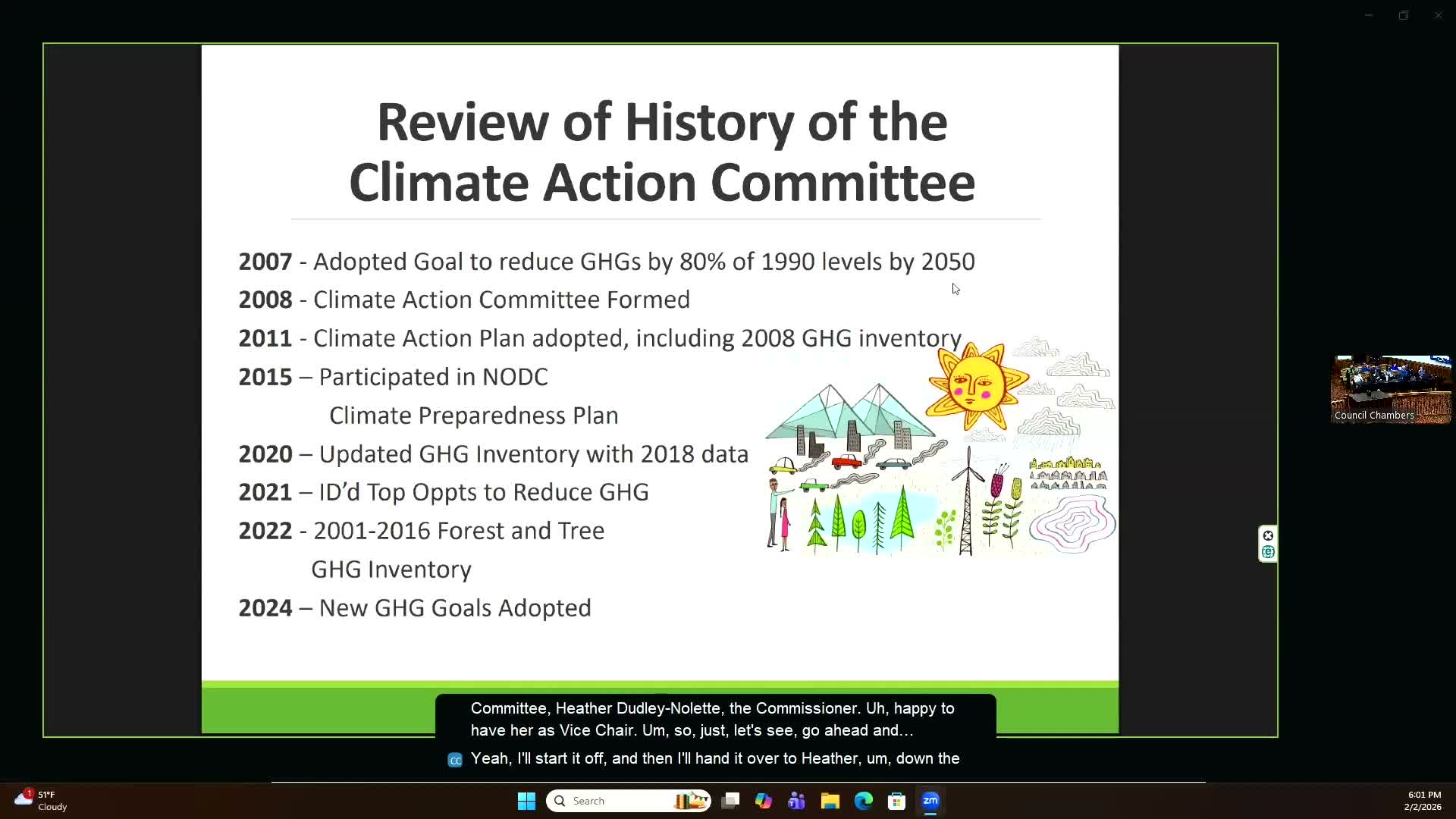
Council members asked how the committee will measure progress. The presenter said the committee has completed periodic inventories (citing work going back to 2005 with an update around 2018), will continue future inventories and is considering interim metrics such as vehicle-miles-traveled (VMT) available from state sources to track year-to-year progress. “We are looking to see if there might be some other metrics we want to track in the meantime,” the presenter said.
The committee framed the work as aligning the city’s and county’s climate targets with the city’s 2026 work plan and recommended using five-year timelines—similar to a recently adopted housing-fund accountability model—to assign responsibilities and track implementation.
The committee asked the council and other partners to engage on community outreach for dense development and climate-risk reduction, and to help identify partners who will carry projects from planning into action. The presentation concluded with an invitation for questions and public comment.
Next steps: the committee said it will continue to develop the action plan, pursue grant opportunities, and identify interim metrics ahead of a more comprehensive inventory update.