Get Full Government Meeting Transcripts, Videos, & Alerts Forever!
Get email alerts on the School Safety topic
No spam. Unsubscribe anytime.
LAUSD officials report declines in fights, threats and weapons; board presses for clearer data and on-campus breakdowns
Summary
LAUSD operations and school police presented year‑to‑date incident data showing declines in several categories; board members and community reps pushed for clearer on‑campus vs. off‑campus counts, regional breakdowns and transparency about reporting methods.
Los Angeles Unified School District officials told the Committee on School Culture and Climate that reported incidents of fighting, threats, illegal substances and weapons have fallen this school year, while board members and community representatives pressed for clearer definitions and more granular data.
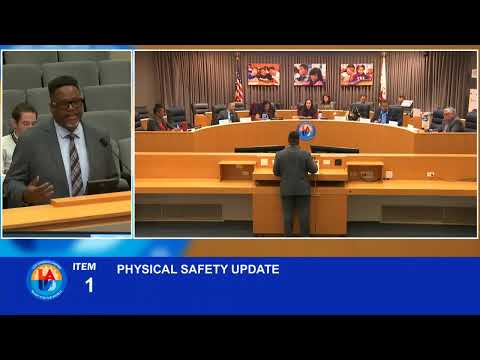
Dr. Alfonso Webb, senior director for the Division of School Operations, told the committee the district’s iSTAR administrative incident reports show reductions from the prior year: fighting and physical aggression down about 22% per 1,000 students, controlled‑substance incidents down roughly 30%, threats down about 21% and weapons‑related incidents down about 23.6% when adjusted for enrollment. Webb said those figures come from iSTAR submissions by school administrators and reflect incidents on campus or while students are traveling to school.
Webb and the deputy chief of LA School Police both cautioned that iSTAR and police report data measure different things. "iSTARs are administrative reports filed by school administrators; police reports reflect crimes reported to or by victims and staff," Webb said, explaining that the datasets can diverge because they are collected for different purposes. The deputy chief added that police records do not always bifurcate on‑campus and off‑campus events in the district’s current records management system and said he has requested system changes to enable that distinction.
The school police deputy chief summarized crime trends from police reports covering the most recent early months across three years. He reported decreases in several serious categories overall, noted a small increase in some measures in Board District 5, and said juvenile arrests remained similar year‑to‑year while total arrests fell about 7%. He also described diversion program use — an approach that routes many eligible youth from court to support services — and said handguns recovered on campus rose from 13 to 17 in the prior year while knives were flat and a miscellaneous "other weapons" category fell substantially.
Board members pressed for follow‑up materials showing (1) how incidents are classified between iSTAR and police records, (2) per‑school or regional breakdowns rather than only board‑district summaries, and (3) historical multi‑year totals that extend before the pandemic to allow meaningful trend analysis. Several public commenters echoed the call for transparent raw totals, while other speakers challenged the district to balance investments in counselors and PBIS (positive behavioral interventions and supports) with any policing presence.
Dr. Webb also outlined protocols the district uses when immigration enforcement is reported near campuses: school staff are advised to contact supervisors, protect student information, and notify school police and general counsel so school leaders can confirm what occurred and communicate with families. The deputy chief said school police observe and report but do not execute federal immigration enforcement.
The committee asked staff to provide the underlying datasets and to return with region‑level and site‑level breakdowns; no formal motions or votes were taken during the session. The district said it will follow up by email with requested clarifications and supplemental tables.