Laurel School District reports student withdrawals and outlines MTSS improvements after limited parent survey
Loading...
Summary
District staff presented unenrollment figures and a small parent survey showing communication, bullying and inconsistent student supports as top reasons families withdrew; the board discussed strengthening MTSS, clearer progress monitoring and targeted training for special-education staff.
The Laurel School District board heard a student-services presentation showing enrollment exits so far this school year and a limited parent-survey summary pointing to gaps in communication and support.
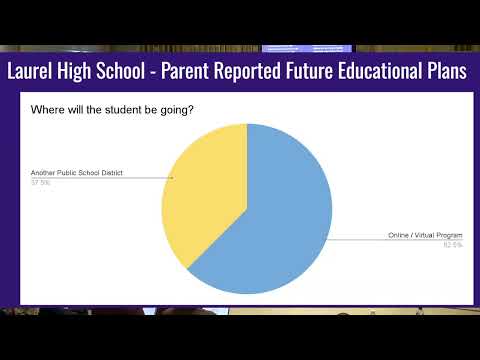
Student-services staff reported 46 unenrollments at the high school, 20 at the middle school, 20 at the intermediate level and 26 at the elementary level, according to an Infinite Campus extract shared with the board. Staff said the district’s automated withdrawal survey drew 22 responses. Among those respondents, the most-cited reasons for unenrollment were communication problems, safety and bullying, insufficient student supports, inconsistency of supports, and school culture concerns.
Melissa Byington, the high school principal, told the board the high school holds grade-level and department meetings to identify at-risk students and to review IEP accommodations. Byington said the school is trying to improve progress monitoring and communication with families and that compliance numbers improved relative to earlier state monitoring: “We have systems in place and progress monitoring; we’re still refining how we turn data into instruction,” she said.
Board members and administrators cautioned the survey sample was small and not statistically representative. One trustee noted only a handful of elementary and middle-school families completed the survey, and another stressed principals also gather qualitative, anecdotal information when parents check out students. Student-services staff agreed the district needs to validate counts in Infinite Campus to avoid double-counting students who leave and re-enroll in the same year.
As next steps, staff outlined immediate goals to improve the district’s family-communication systems and bullying-response processes, midterm goals to strengthen MTSS supports and progress monitoring, and longer-term goals to improve family engagement and data quality across buildings. Board members asked for clearer descriptions of training offered to special-education staff and whether coordinators have allotted time to lead mandatory in-district training rather than voluntary, after-hours sessions.
The presentation closed with a board-wide acknowledgement that about 21.4% of students receive services from student services and that the district should prioritize support for that population. Trustees thanked staff and parents for the input and requested continued reporting and clearer, school-by-school implementation details going forward.
The board moved next to correspondence and the consent agenda.