Get Full Government Meeting Transcripts, Videos, & Alerts Forever!
Get email alerts on the General Plan Update topic
No spam. Unsubscribe anytime.
Consultants present Merced City existing‑conditions workbook, highlight growth, land‑use mismatch and environmental‑justice concerns
Summary
Consultants for the City of Merced presented an "existing conditions and trends" workbook for the general plan update, reporting fast population growth, a mismatch between the plan’s density goals and current zoning, water and air‑quality vulnerabilities, and identifying 14 census tracts as disadvantaged; they invited targeted, multilingual outreach and scheduled an Oct. 23 community open house.
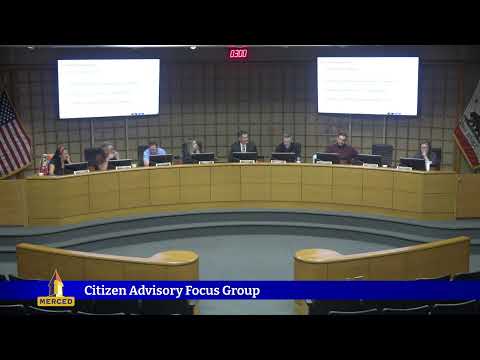
Consultants from Minteer Harnish told the City of Merced’s Citizen Advisory Focus Group on the evening meeting that the city’s population has grown rapidly and that the current zoning does not match the city’s previous 2030 general‑plan density targets.
"My name is Michael Gibbons. I am the project manager for this project and a project manager for Minteer Harnish," Michael Gibbons said as he opened the presentation of the existing conditions and trends workbook. He told the group the workbook is a "snapshot in time" intended to support the general plan update and to prompt discussion about missing or unclear data.
Why it matters: consultants said Merced’s population approaches 98,000 and has increased about 16% between 2020 and 2025. The workbook compares the 2030 general plan’s envisioned land‑use mix (roughly 15% of city land designated as high density and 22% as low density) with the zoning on the ground, which the consultants said shows only about 203 acres zoned for high density while more than 5,000 acres are zoned low density. That divergence, the consultants said, is a core question for the update: should the city rezone to meet the plan’s multifamily goals or adjust the plan’s vision.
Housing, economy and water: Brent Gibbons, the project advisor, summarized the market and housing forecasts and said the team projects demand for roughly 11,000 new housing units through 2045, with about 4,000 in multifamily housing and 7,000 in single‑family categories under the scenarios analyzed. Consultants also reported that in 2020 the city supplied roughly 20,000 acre‑feet of potable water (about 4,000 acre‑feet recycled) and that projected demand could rise toward 32,000 acre‑feet by 2040 if current trends continue; they noted a potential surface‑water treatment plant sized around 10 million gallons per day as one modeled option.
Environmental justice and safety: the team said it ran an environmental‑justice assessment using EJScreen and CalEnviroScreen 4 and identified about 14 census tracts inside the city limits that meet the state’s disadvantaged criteria. "We found the vast majority of collisions in Merced occur within the disadvantaged communities themselves," the consultant said, noting those tracts accounted for the bulk of injury collisions and of killed‑or‑severely‑injured (KSI) collisions in the city’s data. The team proposed targeted, multilingual outreach (Spanish and Hmong were explicitly mentioned, with additional languages available online) and community workshops to collect lived experience from those neighborhoods.
Committee feedback and data requests: members asked for additional raw numbers and clarifying labels (for example, whether graphs show acreage versus dwelling units and whether commuting figures include trips outside the city). Several members requested safety and crash‑breakouts, emergency‑service response times, police/fire per‑capita comparisons, bicycle‑injury counts, and more detailed housing‑amendment histories. Committee member Curtis Thomas requested canopy‑coverage and permeable‑surface data for environmental and flood resilience planning; the consultants said they would seek available datasets and incorporate findings where possible.
Public engagement: staff and consultants announced a public open‑house workshop scheduled for Oct. 23 downstairs at city facilities; the event will be an open‑house format with posters, printed workbooks and staff/consultant stations and will be followed later by a small‑group workshop for alternatives and more hands‑on exercises. Flyers and a social‑media push were promised, and staff asked committee members to provide local partner contacts for targeted outreach.
Formal action: the committee approved the consent calendar (filing of minutes from the Aug. 27, 2025 CAFG meeting) by hand tally; the chair declared the motion passed unanimously.
What’s next: the consultants said they will add raw numbers and clarifying labels to charts, check taxable sales and other comparative tables flagged by members, pursue requested crash and emergency‑service data with city departments, and incorporate targeted outreach materials ahead of the Oct. 23 open house.